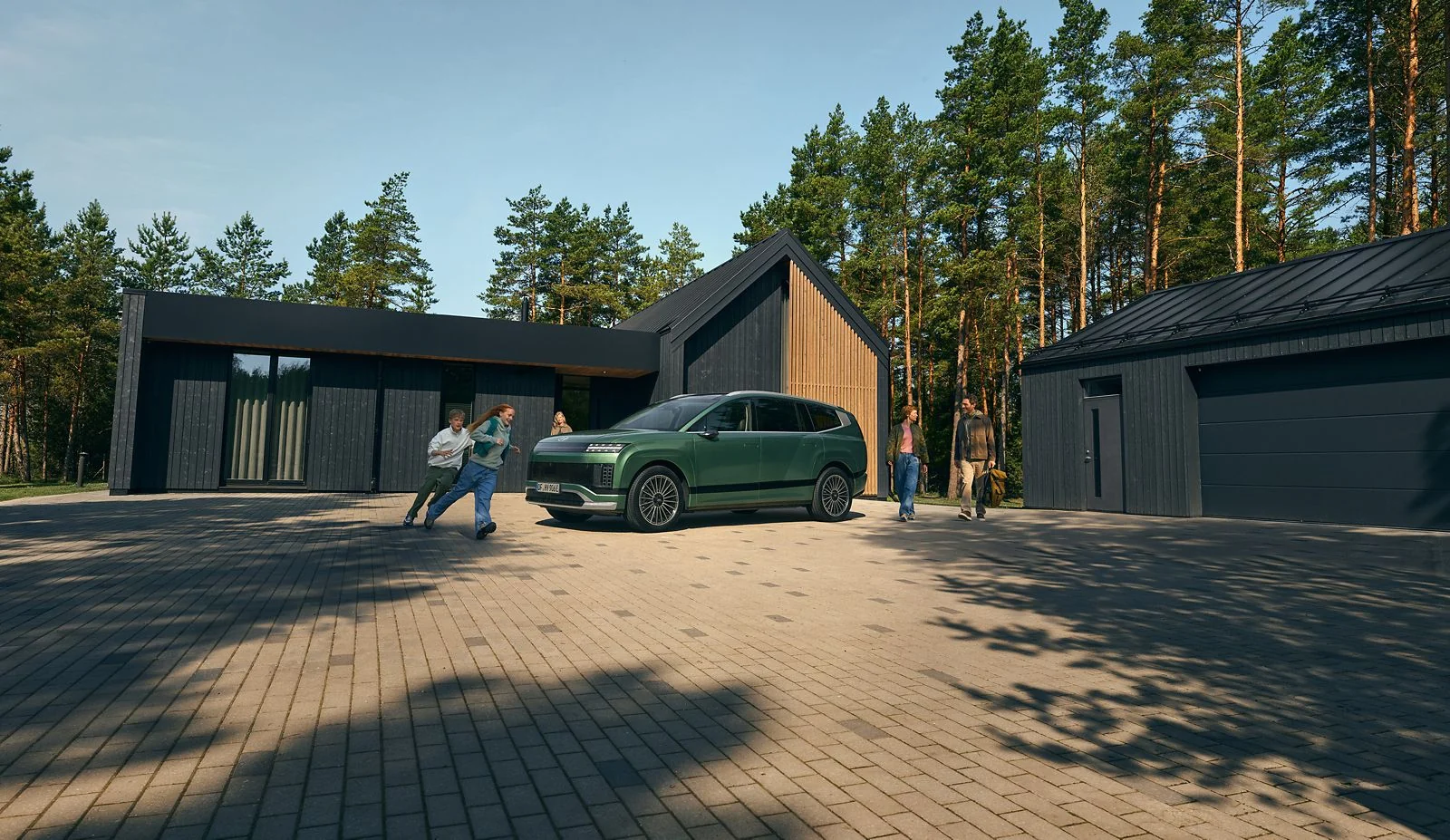
Owners of certain 2026 Hyundai IONIQ 9 vehicles should check the 17-character VIN for NHTSA recall 26V588, Hyundai recall 307. The second-row power-seat logic may not recognize contact with an occupant or object as intended. Until the free software remedy is complete, Hyundai urges affected owners to make sure no one—especially a child—and no object is in the seat or folding area whenever the powered functions are operated.
Recall Scope and the Safety Problem
Hyundai submitted the Part 573 report to NHTSA on September 10, 2026. It identifies 5,360 potentially involved vehicles and estimates that all vehicles in that defined population contain the defect. That figure describes the manufacturer’s identified recall population; it does not mean every IONIQ 9 is included.
Vehicles and trim levels in the reported population
The filing covers certain model-year 2026 Hyundai IONIQ 9 electric vehicles in Limited, Calligraphy and Calligraphy Design trims. The listed production window runs from March 17, 2025 through May 4, 2026. The vehicles were assembled by Hyundai Motor Group Metaplant America for sale in the United States.
Trim and build date are useful screening facts, but the VIN is decisive for an individual vehicle. Production ranges can include breaks or administrative adjustments not visible to an owner. Do not assume a vehicle is clear because its delivery date falls outside the factory window; delivery and production dates are different.
What the second-row seat logic may fail to detect
The NHTSA report says the second-row power-seat assemblies may not respond to contact with an occupant or object as intended during certain powered-seat functions. In some situations, the current logic may fail to detect that contact. Continued powered movement can therefore increase the risk of injury.
The seat moves only when an operator activates the relevant control switches; there is no warning described in the report that independently announces the defect. That places added importance on visually clearing the seat and its folding path before every activation. The recall concerns control logic and anti-pinch response, not a claim that a seat will move spontaneously.
The involved components are the left and right second-row power-seat units, part numbers 891P8-TD000 and 892P8-TD000. Owners do not need to dismantle a seat to find these parts. A VIN lookup and dealer software inspection are the intended identification and remedy route.
Check the VIN Instead of Guessing from the Build Date
The Vehicle Identification Number connects a specific car to Hyundai’s campaign records. The Part 573 filing says VINs were scheduled to become searchable on September 12, 2026. Run the lookup even if the owner letter has not arrived.
Find the 17-character VIN
Hyundai points owners to the driver-side dashboard at the windshield, the label inside the driver-side door jamb, the insurance card and the vehicle title. Copy all 17 characters. Photographing the dashboard plate can reduce transcription errors, but keep that image private because a VIN is a persistent vehicle identifier.
Do not use the partial VIN patterns printed in the technical report to decide inclusion. They are chronology examples with masked characters, not a consumer lookup table. Enter the complete VIN from the vehicle into an official tool.
Use Hyundai and NHTSA recall lookup tools
Hyundai’s Safety Recalls and Service Campaigns lookup accepts a 17-digit VIN, displays remedy information and supports dealer scheduling. NHTSA also operates a VIN recall lookup. Checking both can help an owner confirm the campaign number and distinguish a safety recall from a service campaign.
Use the direct Hyundai or NHTSA domain rather than typing the VIN into a search-engine result that merely summarizes recalls. A legitimate recall remedy is free; a site that requests payment simply to reveal open recalls is unnecessary.
Read an open or completed recall result carefully
An open entry for 26V588 or campaign 307 means the remedy remains outstanding in the record. Save the result and contact a dealer, even if an OTA message is expected. A completed result should align with a dealer invoice or in-vehicle software-update confirmation showing that the recall work was applied.
If no result appears, recheck every character and try the other official lookup. A newly entered campaign can take time to propagate across systems. A vehicle that fits the model, trim and build window but still returns nothing should be discussed with a Hyundai dealer using the full VIN rather than declared unaffected from a single blank screen.
Never post the full VIN in an open forum to ask whether the recall applies. Owners can discuss the campaign number and trim publicly while reserving the unique identifier for Hyundai, NHTSA and trusted service providers.
Protect Occupants Before the Software Remedy
NHTSA’s filing does not issue a do-not-drive or park-outside instruction. It does give a specific interim precaution for the powered second row. Every person who operates the vehicle should understand it, including valets, relatives and service staff.
Keep children and objects out of the folding area
Hyundai urges affected owners to exercise caution and ensure that occupants, especially children, are not in the seat or seat-folding area while the powered functions operate. Clear toys, bags, child-seat components, blankets and cargo from the movement path. Visually confirm the space instead of relying on the anti-pinch logic to detect an obstruction.

A child should not operate the switches or play near a seat while another person uses the controls. Adults should supervise loading and unloading and complete seat positioning before a child enters the area. If an occupied seating position needs adjustment, use only the instructions in the owner’s manual and avoid the affected folding or stowing operation until the occupant is clear.
Control every powered-seat activation
The report says these power functions require an operator to activate the seat-control switches. Before touching a switch, identify which seat will move and where it will travel. Maintain a direct view throughout the motion. Release the control immediately if a person or object enters the path or if movement appears abnormal.
Do not stage an obstruction to test whether the sensor response works. That can recreate the condition the recall is intended to correct. Similarly, do not attempt a software workaround, disconnect a controller, pull fuses or modify seat wiring. The remedy is a Hyundai software inspection and logic update.
Households can place a temporary reminder near the rear-seat controls and explain the rule to every driver. Fleet or rideshare operators should add the precaution to the vehicle note until the VIN record shows completion. These steps reduce exposure while the remedy is arranged; they do not replace it.
Understand the Dealer and OTA Remedy Paths
The repair is software-based, but “software recall” does not mean every owner can resolve it immediately from home. The NHTSA filing provides a dealer route for all affected vehicles and an OTA route when available for eligible, opted-in Bluelink vehicles.
What a Hyundai dealer will inspect and update
Hyundai will instruct owners to bring affected vehicles to a dealer. Technicians will inspect the Seat Controller software version and update the logic for the rear power-seat functions. The replacement logic revises the rear-seat system’s anti-pinch protection.
When scheduling, provide the VIN and refer to NHTSA 26V588 / Hyundai 307. Ask whether the remedy is available and how long the software inspection is expected to take. The dealer invoice should show the campaign and a zero-charge recall operation, even if unrelated maintenance is performed during the same visit.
When an over-the-air update may apply
The filing says Hyundai will provide an over-the-air update when available for eligible vehicles whose owners have opted to receive updates through Hyundai Bluelink. Those conditions matter. An owner should not postpone an available dealer remedy solely because the vehicle has general OTA capability.
If Hyundai offers the update to a particular VIN, follow the in-vehicle and MyHyundai instructions, maintain the required vehicle state and let installation finish without interruption. Save the completion screen or message. If an update fails, disappears or does not clearly identify the safety campaign, contact Hyundai or a dealer rather than assuming the background installation succeeded.
Why warranty status does not remove eligibility
The remedy is offered at no cost for all affected vehicles, regardless of whether the New Vehicle Limited Warranty still covers the car. A used-vehicle owner, lessee or owner who services elsewhere can still use the VIN to request the recall remedy from Hyundai.
A dealer may recommend unrelated paid work, but that should be separated from the free recall line item. Ask for an explanation before authorizing additional charges. Safety recall eligibility follows the affected VIN and open campaign, not the remaining duration of the ordinary warranty.
Put the Complaint and Investigation Record in Context
The Part 573 chronology is more useful than viral posts because it identifies what Hyundai knew at the recall decision and how testing progressed. It also prevents unrelated power-seat stories from being attributed to this IONIQ 9 campaign.
Consumer complaints, alleged injuries and reported outcomes
As of Hyundai’s September 2, 2026 recall decision, the company was aware of five U.S. consumer complaints involving the condition, including two alleged minor injuries. The report says there were no U.S. crashes or fires related to it. These are the manufacturer’s dated figures in the regulatory filing.
The wording “alleged minor injuries” should be preserved rather than converted into a detailed diagnosis that the report does not supply. Likewise, no crash or fire report does not make the pinch or entrapment risk trivial. The safety concern is contact during powered seat movement and the resulting increased injury risk.
How testing led to the recall decision
Hyundai’s North America Safety Office received preliminary cross-model benchmarking in March 2026. From March through June, internal and independent engineering teams discussed further testing, subjective evaluations and biomechanical methods. A dedicated fixture was then developed and benchmarked in July and August.
On August 14, Hyundai says testing showed force measurements for certain second-row power folding and stowing systems above limits established by its safety office and the third-party engineering firm, while tested third-row systems were below those limits. Hyundai decided on September 2 to recall affected 2026 IONIQ 9 vehicles.
This chronology explains why a software response was chosen without inviting owners to reproduce the force tests. It does not support attaching every online complaint about a Hyundai rear seat to campaign 307. The individual vehicle must match the campaign by VIN, and incident reports should identify the exact model and operation involved.
Confirm the Recall Is Complete After Service or OTA
A quieter seat or a newer-looking app screen is not enough to document completion. Preserve an official service or update record, then make sure the VIN status eventually reflects the remedy.
Save the dealer record or update confirmation
For dealer work, keep the repair order showing campaign 307 or NHTSA 26V588, the service date and the completed software operation. Confirm that the recall line is closed at no charge. For OTA work, save the vehicle or MyHyundai message identifying the completed power-seat safety update and its installation date.
If an installation fails or remains paused, continue the interim precautions and contact Hyundai. Do not repeatedly activate the second-row seat as a completion test. A successful software record is stronger evidence than subjective changes in motor speed or force.
Recheck the VIN and seat operation instructions
Run the Hyundai VIN lookup again after allowing time for service systems to synchronize. If the campaign remains open despite a completion document, contact the servicing dealer with the repair-order number. If it is marked complete but no owner or service record exists, ask Hyundai to explain when and how the remedy was recorded.
Read any revised operating guidance supplied with the update. New logic can alter how powered folding, stowing or anti-pinch behavior feels. Continue to clear occupants and objects from the movement path; safety features do not replace direct supervision around powered seats.
Ask about qualifying prior repair expenses
The NHTSA filing says Hyundai will reimburse owners for out-of-pocket expenses incurred to obtain a remedy for the recall condition in accordance with its submitted reimbursement plan. That statement does not guarantee every diagnostic or prior repair bill will qualify.
Keep itemized invoices, proof of payment, the VIN and a description of the concern that led to the work. Ask Hyundai for the current reimbursement instructions and deadline. Submit copies rather than surrendering the only originals, and keep the claim confirmation with the recall file.
Questions Current and Used-Vehicle Owners May Have
Owner notification and OTA delivery may occur later than the public filing, so the VIN lookup is the best current starting point. The answers below apply to campaign 307; a vehicle can have other open recalls that require different precautions.
Can the vehicle still be driven before repair?
The Part 573 report does not issue a do-not-drive or park-outside advisory. Its interim instruction is caution when using the second-row powered folding functions and keeping occupants, especially children, and objects out of the seat and folding area. Owners with damaged seats, abnormal movement or a prior incident should contact Hyundai or a dealer for advice specific to that vehicle.
A lack of a general driving prohibition should not be turned into a universal safety declaration. Follow every open campaign shown for the VIN, because another recall may carry a different instruction.
What if no recall letter has arrived?
Hyundai’s filing planned phased remedy-owner notification for November 9, 2026, while VIN searchability was scheduled for September 12. An owner does not need to wait for postal mail to run the VIN and contact a dealer about an open result. Make sure Hyundai has the current address, especially after a used purchase or move.
A mailed notice is useful documentation but it is not the only proof. Print or save the official VIN result. If a dealer says the remedy is not yet available, ask to be notified when scheduling opens and continue the interim precautions.
What should a used-car shopper verify?
Enter the VIN into Hyundai’s and NHTSA’s tools shortly before purchase. Ask the seller for the dealer repair order or OTA completion message if campaign 307 is shown as closed. If it is open, confirm with a Hyundai dealer that the free remedy can be scheduled and decide how the interim seat restriction affects the planned use.
Recall work is offered without regard to the remaining new-vehicle warranty, but the buyer should still document ownership promptly so future notices reach the correct person. Do not accept a verbal statement that “the software updated itself” without a VIN status or identifiable update record.
Product Recall Checker is an independent information site and cannot access a Hyundai service account, change a VIN record or complete the OTA installation. Use the official VIN result and NHTSA filing for final decisions, and keep children clear of the powered-seat path until the remedy is documented.
Comments
Comments are reviewed before publication. Do not post personal information, serial numbers, medical details, or emergency reports. For urgent safety concerns, use the official agency contact in the recall notice.
Sign in with Google to leave a comment
Loading comments...