A chicken recall list is useful only when its product name, package size and printed codes match what you bought. This guide checks selected U.S. notices from 2026, including frozen chicken, prepared meals and foodservice products, and explains how to use USDA establishment numbers without mistaking an entire brand for a recalled lot. It also separates the retracted Great Value dinosaur nugget alert from recalls that require action. Checked October 9, 2026; it is not a complete live inventory. Product Recall Checker is an independent website, and the issuing agency's latest notice determines the affected products and instructions.
How to read a chicken recall list for 2026
Start with the announcement date, then read the product row and any later update. A best-by date in 2026 does not necessarily mean a recall was announced in 2026. Conversely, a recall announced this year can cover frozen products with dates extending into 2027. If you are looking at an old news headline, follow its official link and check whether the notice was expanded, closed or retracted before applying its original instructions.
The USDA Food Safety and Inspection Service, or FSIS, is the main federal source for meat and poultry recall notices. The FDA's recall guidance points readers to FSIS for those products and describes the identifiers companies use: product names, packaging, UPCs, production codes, dates and distribution. For chicken, look beyond a bag of plain meat. Croquettes, fried rice and other prepared meals may have their own branded package and product list. Search the name on your actual wrapper, not just the word “chicken.”
The examples below are selected notices that illustrate different ways to check a package. They are not every chicken-related action issued during the year, and they do not establish that all products from a listed manufacturer are affected. For a new alert or a product not discussed here, open the FSIS recalls and public health alerts index and the manufacturer's current notice. Compare the exact description rather than treating an omitted brand as a safety determination.
The inspection number is one part of the match
The FSIS explanation of recalls describes establishment numbers as identifiers assigned to producing establishments; poultry numbers use a P prefix. An EST. or P number is different from the retail barcode and from the lot code. Copy the prefix and digits exactly from the label, then compare the other fields in the notice. Do not assume that every product bearing the same plant number was recalled.
A useful comparison record has separate spaces for brand and product, package size, establishment number, lot or production code, best-by or sell-by date, and purchase location. Leave an unavailable field blank rather than guessing it from another package. A photo of the inspection mark and date panel helps a manufacturer answer a question about a partially readable wrapper. The notice may identify different packages with different codes, so repeat the comparison for each item in a multipack or freezer collection.
Frozen chicken meals in the 2026 Ajinomoto recall
The Ajinomoto Foods North America event is a significant chicken-meal example from 2026 because its scope changed after the first announcement. The initial February 19 recall concerned frozen chicken fried rice and possible glass contamination. The March 3 expansion included additional fried rice, ramen and shu mai products under Ajinomoto, Kroger, Ling Ling, Tai Pei and Trader Joe's brand names. The Defense Logistics Agency's official March 4 memorandum records the expansion and links the USDA product list. Some expanded products contain pork rather than chicken, so a chicken guide should not turn the entire expansion into a list of chicken items.
Most importantly, the USDA's March 9 correction states that products with the listed lot numbers are recalled regardless of their best-by date. A package cannot be excluded solely because its printed date falls outside a range copied from the February story. Check the latest expanded list by product and lot, then use the label pictures to resolve which identifier belongs to which field.
The February notice and March expansion
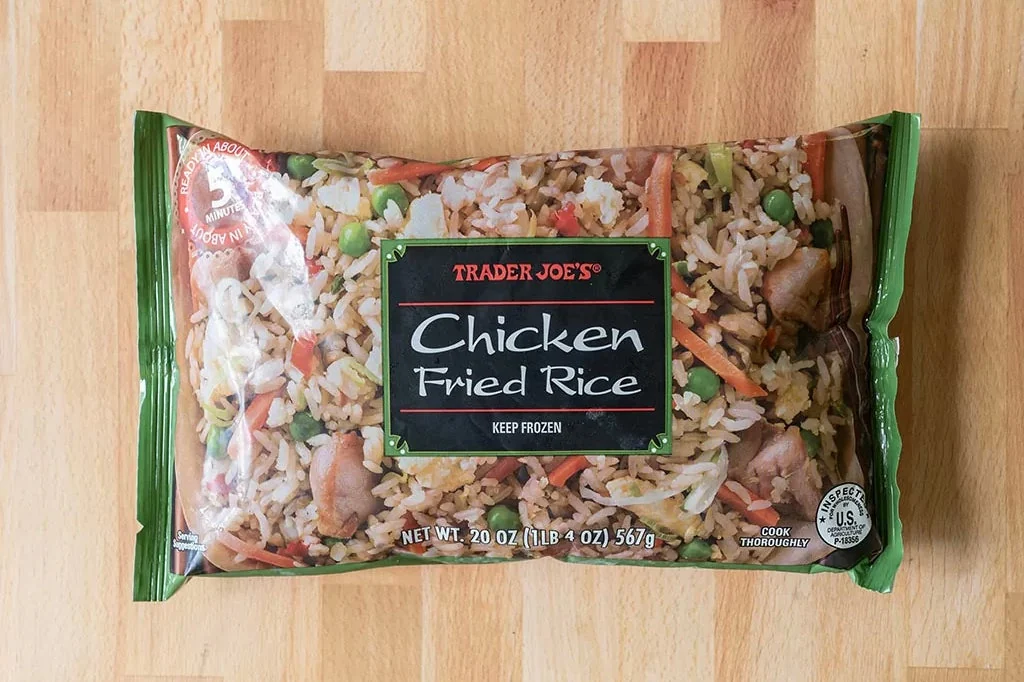
Trader Joe's identifies its Chicken Fried Rice with SKU 33251. The retailer's February 20 notice initially described best-by dates from September 8 through November 17, 2026. Its March 3 recall archive entry expanded the Chicken Fried Rice date range to March 4, 2026, through February 10, 2027, and separately listed Chicken Shu Mai dates from March 13 through October 23, 2026. Those ranges show why a shopper should read the expansion rather than stop at the first news report. The later USDA lot-number correction still needs to be considered.
The original Trader Joe's Chicken Fried Rice identification described a 20-ounce plastic bag with establishment number P-18356. The expanded government product identification lists P-18356, P-18356B and P-47971 across its products. Those numbers help you find the relevant rows, but they are not interchangeable lot codes. A matching plant number alone does not identify which product or production batch is affected, and a different package format needs its own row. Preserve the complete number, including any final letter, when you photograph it.
For its affected products, Trader Joe's instructed consumers not to use them and to discard them or return them to any Trader Joe's for a full refund. Its listed Customer Relations number is 626-599-3817, Monday through Friday, 6 a.m. to 5 p.m. Pacific time. If a date-range screenshot conflicts with your lot check, ask the retailer about the March 9 USDA update rather than using the earlier range to clear the package yourself.
Match the expanded list by lot number
One directly readable retailer example is SpartanNash's March 5 Ling Ling notice. It identifies Yakitori Chicken Fried Rice in a 17-ounce package with UPC 0-10878-81089-2, lot 81096-17-2-5167 and an expiration date of December 13, 2026. Keep every part of that lot string, including the hyphens. This is one retailer's affected chicken row, not the full set of lots from the federal expansion.
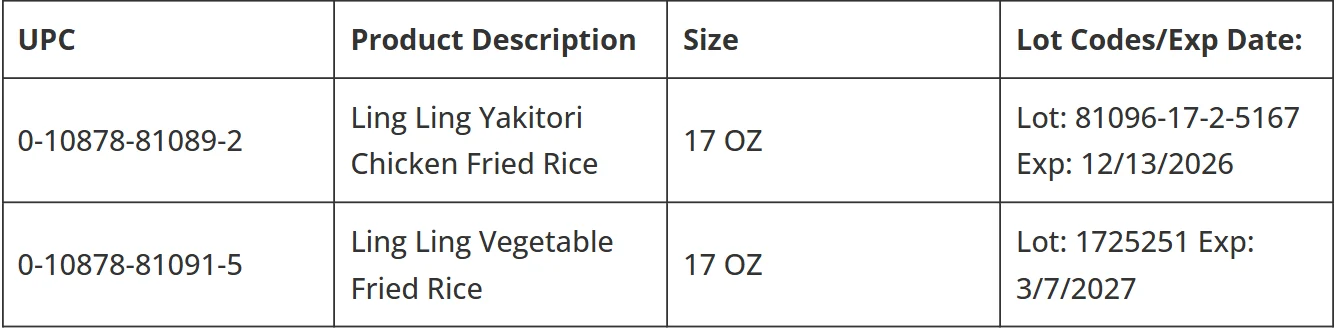
Use the USDA expanded product list for the complete comparison. If that document will not load, contact the manufacturer or retailer with your exact product and lot; an inaccessible attachment is not evidence that your bag is unaffected. SpartanNash's notice directed consumers not to use the listed product and to return it for a refund or replacement, and provided Ajinomoto's consumer number, 866-536-8008, for questions. Do not try to pick out visible fragments or use normal cooking instructions as a remedy for a recalled glass-contamination product.
Foodservice buffalo chicken boxes require a separate check
The Shanghai Ravioli Corporation notice, FSIS 018-2026, concerns foodservice boxes rather than the retail fried-rice bags above. Announced August 26, 2026, it covered approximately 24,900 pounds of frozen, not-ready-to-eat Buffalo chicken products produced without federal inspection. The official FSIS API lists this recall as closed at the October 9 check. That administrative status does not change which products the original notice identified or make a stored affected box appropriate to serve.
| Product on the case label | Case contents | Sell-by dates |
|---|---|---|
| Buffalo Chicken Rangoon | 100 pieces | July 8, 2026–June 29, 2027 |
| Benedetto's Buffalo Chicken Mozzarella Stick | 120 pieces | July 8, 2026–June 29, 2027 |
The boxes bore false inspection marks with establishment number EST. 18004, which the notice says did not have a federal grant of inspection. This is an important exception to any assumption that an inspection-style symbol alone establishes a product's status. Compare the full product description and case dates with the notice. Here, the establishment number helps identify the affected labels precisely because its use was part of the problem.
Distribution was to foodservice locations in Maine, Massachusetts, New Hampshire, Rhode Island and Vermont. An operator should examine outer-case labels and supplier records, including stock transferred to another freezer. A customer who ate a prepared meal may not have that packaging; asking the restaurant which supplier and product were used can help identify whether this notice is relevant. A menu description such as “Buffalo chicken appetizer” is too broad to establish a match.
The announced instructions were not to serve the affected products and to discard them or return them to the purchase location. Questions were directed to Shanghai Ravioli's quality-control manager at 617-989-3833 or [email protected]. If you manage inventory, record the case identification and disposition so the same affected stock is not counted as a fresh delivery or returned to use later. The announcement's 24,900 pounds is the recalled quantity; an agency field showing pounds recovered describes a different measure and should not replace it when explaining the event.
The Great Value dinosaur nugget alert was retracted
The Great Value dinosaur nugget story should not appear as an active lead-related chicken recall. FSIS issued a public health alert on April 1, 2026, then retracted it in an announcement dated April 6. The agency concluded that the Dorada Foods product did not pose the public health concern described in that alert. Some health-department and news updates were posted on April 7; those publication dates should not replace the date printed in the FSIS retraction itself.
For recognizing the old story, the original identification was a 29-ounce bag of Great Value Fully Cooked Dino Shaped Chicken Breast Nuggets, with approximately 36 pieces, lot 0416DPO1215, establishment number P44164 and a February 10, 2027, best-if-used-by date. Those fields identify the subject of the withdrawn alert. They are not a new instruction to discard that product for lead contamination. The original FSIS bulletin also said a recall was not requested because the products were no longer available for purchase; the agency had issued an alert for possible stock in home freezers.
The retraction explained that follow-up testing of the original lot and additional lots found no elevated lead levels. FSIS reviewed the laboratory information with New York's health department and determined that the original result was a false positive caused by sporadic lead contamination during laboratory analysis, rather than contamination of the nuggets. The agency's updated finding supersedes the old alert's lead warning and its associated advice.
This is why a freezer search should include status verification, not just a visual match to a widely shared package photo. If the headline you found says “lead in chicken nuggets,” open the latest agency statement before acting on it or forwarding it. Keep the retraction link with any saved notice so a later reader sees the correction. The finding applies to this particular alert; it is not a guarantee about every future nugget product or every possible food-safety concern. For a different package or a new notice, start a separate identifier check rather than extending this correction beyond its stated scope.
Verify your package and follow its recall instructions
For each chicken item you want to check, put the package next to the latest official notice and compare the identifying fields in order. Confirm the exact product and size, then its establishment number and lot or date rule. Read any editor's note before making a decision. The Ajinomoto correction shows why the order matters: a listed lot remains relevant even when a date-only comparison appears to exclude it. The dinosaur nugget retraction shows why a matching historic label can lead to an updated finding rather than an active warning.
You can use the food recall category or latest recall records to find possible notices, then open the official source for confirmation. Search results are a starting point, and a result count is not a verdict about the food. If you cannot resolve a code or the agency attachment fails to open, ask the issuing company or USDA rather than guessing which package was intended.
When the wrapper or purchase record is incomplete
A receipt or online order can identify the product, store and purchase date, but may not contain a manufacturing lot. Tell the representative exactly what you still have: an outer carton, an inner bag, a receipt, a saved image or a container of transferred food. Do not create a lot number from a best-by date or borrow one from an image of another customer's package. Manufacturer codes can contain information intended for internal tracking, and they do not share a universal consumer decoder.
For a partially readable wrapper, photograph the product front, inspection mark, barcode and printed code panel without cropping out adjoining text. Keep the original spelling and punctuation when copying a code into a message. If several bags were purchased together, document each remaining bag; the same shopping trip does not prove that all came from one batch. When asking about a restaurant meal, provide the location and date and ask the business to check its supplier records. That is more useful than assigning a retail UPC to food that arrived in a bulk case.
Returns, disposal and reporting a problem
Follow the affected product's stated return or disposal instructions. A retailer's refund or replacement offer applies to its notice; it should not be presented as a universal promise from every seller. Confirm what purchase evidence the retailer needs before transporting the food. Do not pass a confirmed recalled item to someone else or feed it to a pet as a way to avoid waste. If you have already eaten it and are concerned about illness or injury, contact a healthcare professional and describe the exposure.
If you discovered glass or another problem and want FSIS to investigate, evidence handling differs from ordinary recall disposal. The FSIS reporting guidance calls for the original packaging, any foreign object and an uneaten portion kept refrigerated or frozen. Contact the agency for handling instructions before disposing of potential evidence. Its electronic consumer complaint form collects product codes, package dates, establishment numbers and purchase details, and allows supporting photographs. The USDA Meat and Poultry Hotline is 888-674-6854. Restaurant food-safety concerns can also be directed to the local public-health authority; a medical concern should receive care independently of any complaint or refund request.
Comments
Comments are reviewed before publication. Do not post personal information, serial numbers, medical details, or emergency reports. For urgent safety concerns, use the official agency contact in the recall notice.
Sign in with Google to leave a comment
Loading comments...