
Check the exact recipe, package size, lot number and best-by date before deciding that your dog's food is recalled. This guide explains selected, verified 2026 FDA notices for wet food, raw food and treats, checked on October 9, 2026. It is not an exhaustive live inventory. Open the linked official notice for the current affected scope and instructions.
If your package matches, stop feeding the affected product and follow that notice. Ask your veterinarian about symptoms or a replacement diet when your dog has a medical feeding plan. Product Recall Checker is independent and does not replace FDA, a manufacturer or veterinary care.
How to read a 2026 dog food recall list
The FDA animal recall index is a starting point for finding the original announcement. Its entries identify dates, brands, products, reasons and recalling companies. Those fields tell you which notice to open; they do not replace the package-level identification inside it. A company can recall one lot or one recipe while other items bearing the same brand fall outside that particular action.
Begin with the food's complete name and its original container. “Chicken dog food” is too broad to resolve an individual package. Raw chicken recipes, canned chicken meals and chicken treats have different notices and identifiers. Write down the formulation and size before searching so that a result for a familiar brand does not distract you from a different product.
A recall, an advisory and a cat-only notice are different
FDA also maintains animal outbreaks and advisories. An advisory can tell owners not to feed a product even when the information is not presented as a company's voluntary recall announcement. That distinction matters when describing the event and when looking for a refund: the safety instruction deserves attention, but it does not justify inventing a company remedy that the source never offers.
The animal index also includes foods, medicines and other products for species besides dogs. A feline milk-replacer entry should not become a dog-food warning because both appear on the same FDA page. Some notices cover both dog and cat recipes; in those cases, match the species-specific product entry. Do not substitute a cat product's weight, lot or barcode for the dog's recipe.
Dates need the same care. A notice issued in 2025 can remain relevant to an unopened package during 2026, but it is still a 2025 notice. A later update may revise identifiers or instructions without creating a new event. FDA's “terminated” designation describes completion of specified recall efforts; it does not mean an old affected package left in your home has become acceptable to feed.
The examples below provide useful package checks across different formats. To investigate a food absent from those examples, search both official indexes and the manufacturer's current notice page. Absence from this selected guide is not a safety verdict. It simply means this article has not documented a matching entry for that product.
Verified 2026 wet dog food examples
These canned-food examples show why a familiar brand name is not enough. Each notice names a particular recipe and specific codes. Read a can's label and its stamped information before opening it; an unopened can still provides the identifiers needed to investigate. If you bought several cans together, check them individually rather than assuming they all share the same production run.
PEDIGREE chicken and duck cans
The July 2, 2026 PEDIGREE announcement covers High Protein Chopped Chicken & Duck Flavor wet dog food in 13.2-ounce cans, lots 613C3KKCFC and 613C1KKCFC. The notice describes potential sharp metal and plastic foreign material and says those lots apparently entered the marketplace after being sent for destruction. It does not describe a recall of every PEDIGREE recipe.
Do not feed the listed product. The announced remedy is to contact PEDIGREE for a replacement, at 1-800-525-5273. Its official pictures show the lot location on the bottom of the can. The announcement does not supply a UPC or best-by field to add to this example, so a barcode or date found in another web page should not be substituted for the two stated lot codes.
Fromm Turkey Pate and Milo's Meatloaf
The August 21, 2026 Fromm notice concerns possible metal contamination in two canned recipes distributed through pet stores and online outlets in the United States and Canada. Both listed entries carry Best By 032029, but their sizes, UPCs and lot endings differ.
| Recipe | Can size | UPC | Lot code |
|---|---|---|---|
| Turkey Pate | 12.2 oz | 072705118700 | EP2A3306 551006 |
| Diner Classics Milo's Meatloaf Pate | 12.5 oz | 072705132324 | EP2A3306 551029 |
Stop feeding a matching product and return it to the retailer as the notice directs. Questions go to Fromm at 1-800-325-6331. The notice excludes other Fromm products; it does not establish a refund promise for every purchase channel.
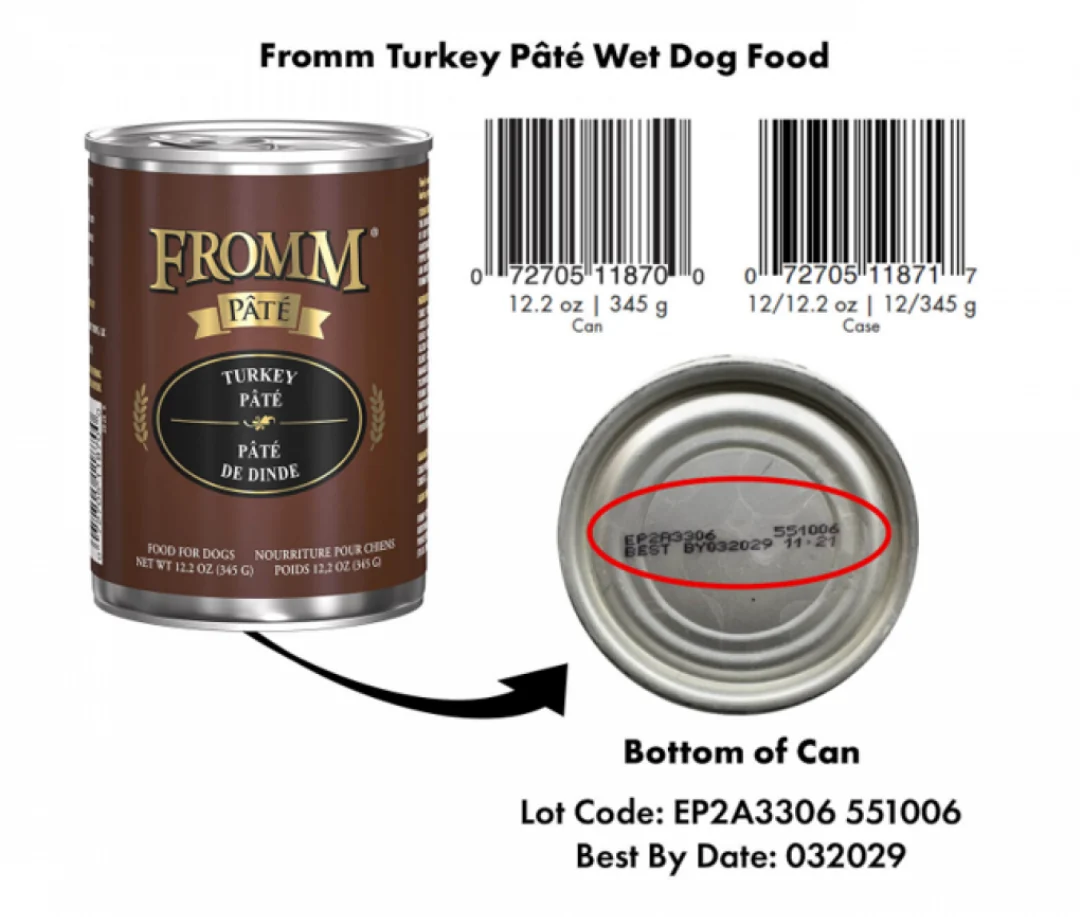
A photograph of the label is useful context, but your can's code remains decisive. Keep the Turkey and Milo's entries separate in any household note. Copying only their shared Best By print would remove the very information that distinguishes the two affected products.
Raw food and treat notices need their own lot checks
A frozen brick and a bag of treats are easy to overlook when a headline mentions “dog food.” Include both in your search. The relevant container may be an individual pouch inside a larger case, and the code may be printed on a back panel rather than beside the product name. Work from the notice's specific format and photographs instead of expecting all pet-food identifiers to appear in the same place.
Albright's Chicken Recipe
The Albright's announcement dated May 6, 2026, published by FDA on May 7, covers Chicken Recipe for Dogs Complete and Balanced, frozen one-pound bricks in clear vacuum packaging, generally in 30-pound cases. The listed lot is C001730, with Best Buy/Expiration 28-Apr-27. The notice's product-identifier field is 20855404008367.
The reason is potential Salmonella contamination. Do not feed the identified lot. The notice tells owners to dispose of unconsumed affected product so children, pets and wildlife cannot access it. For a requested refund, it specifies submitting a receipt, product photographs and purchase information to [email protected]; questions can also go to 866-729-4738. Retain the identification information before following the disposal instruction.
Older Albright's search results can describe different packages and lots. Confirm the notice year and C001730 rather than assuming that every Chicken Recipe result describes this event. Likewise, the large identifier supplied in this notice should be copied as given, not shortened using a barcode rule from an unrelated retail product.
Elite Treats Chicken Chips
The February 24, 2026 Elite Treats notice identifies Chicken Chips for Dogs in a six-ounce black-and-gold bag, lot 24045, expiration 04/2027, printed on the back. The product was distributed to feed stores in Alabama, Florida, Georgia, North Carolina and South Carolina. Its reason is possible Salmonella contamination.
FDA now marks this recall completed and terminated. Keep that status with the historical example; do not describe it as a newly active October event. A leftover matching bag still warrants the notice's instructions: cease using it, do not sell or donate it, and dispose of it where children, pets and wildlife cannot reach it. Contact 561-901-5310 for information about return arrangements for a refund or replacement. The termination banner does not turn a matching old lot into food to use up.
Check the package before feeding or discarding it
FDA's lot-number guidance explains why a code matters when investigating pet food. A UPC identifies a product type; a lot helps identify a particular production batch. Keep both where the notice supplies them. A brand, a receipt or a feeding subscription name may help find a purchase but usually cannot replace the package's stamped information.
For each suspect container, record six practical fields: full brand and recipe, species, package size, UPC or other listed identifier, full lot code, and best-by or expiration date. Add where and when you bought it. Compare the package information with one official notice at a time. A clear match follows all of that notice's applicable fields; a partial match should be described as partial until the company clarifies it.
Take photographs before disposal if you can do so without handling the food unnecessarily. Capture the front panel, the code and the date. Do not edit a photograph to replace an unclear digit with your best guess. If your package's print is damaged, send the unaltered view to the manufacturer and explain what you can and cannot read. That is more reliable than picking the nearest-looking code from a search result.
If kibble or treats have been poured into a storage bin, look for the original bag or a saved label photograph. FDA's storage guidance recommends keeping the original container or bag. When different purchases have been mixed in one bin, acknowledge the uncertainty instead of assigning the newest bag's code to all the contents. Tell the manufacturer about the mixing if you need help resolving scope.
Normal appearance is not a substitute for identifiers. Do not taste a treat or open a can simply to decide whether it is affected. The recalled packaging may look ordinary, and an unrelated packaging defect may need investigation even without a recall match. If the specific notice tells you to discard the food, save identification photographs and follow that instruction rather than keeping the affected product as a household sample.
Organizing this information also makes an FDA pet-food complaint more useful. A factual record of the product and timeline supports follow-up; it does not by itself prove that the food caused a dog's symptoms.
Protect your dog and your household after a match
First remove the affected product from feeding. Then follow the product-specific return, replacement or disposal instruction. Those tasks solve different problems: removing the food prevents another serving, the remedy handles the recalled item, and cleaning addresses material that may already have contacted equipment. None replaces another, and cleaning a bowl does not make a matching package acceptable to feed.
When to contact a veterinarian
FDA's Salmonella guidance explains that infected pets can have digestive or general illness signs and can sometimes carry the organism without obvious symptoms. Contact your veterinarian if your dog ate an affected product and is ill, or if you are concerned about possible infection. Vomiting, diarrhea, reduced appetite or unusual lethargy are information to report, not a way to diagnose the cause from home.
A foreign-material notice raises a different question from a bacterial notice. Tell the veterinarian the actual recall reason rather than simply saying “contaminated food.” Include the recipe, size, lot, approximate feeding times and symptoms. For a dog on a prescription or otherwise medically supervised diet, ask for an appropriate replacement feeding plan. Do not keep feeding a recalled lot to avoid a diet change, and do not independently substitute medications or supplements as a response.
Handle the recalled food and feeding equipment carefully
FDA's pet-food handling guidance recommends handwashing and washing bowls and measuring utensils with soap and hot water after use. Keep children away from the affected food and from the cleanup. If a notice requires disposal inaccessible to children, pets and wildlife, an open bag left beside a bin does not accomplish that instruction.
Consider what touched the product: a scoop, bowl, storage container, counter or an opened package. Follow the notice's cleaning and sanitizing instructions for those items. Do not invent a chemical mixture or assume that a rinse establishes sterility. Keep unaffected food separate while cleaning, and avoid using a feeding bowl itself to scoop from a fresh bag.
The CDC pet-food safety page also addresses risks to people who handle pet food. A person with symptoms after contact should seek healthcare advice and mention the exposure. An apparently well dog does not settle the household exposure question. Preserve useful code photographs for reporting, while keeping health decisions with the appropriate human or veterinary professional.
Keep an update record for the food you actually buy
Use a short purchasing record to make the next recall check easier. For a recurring food delivery, take a label and code photograph when each new package arrives. Save it with the purchase date, seller and recipe. A subscription repeatedly sending the same product name does not mean each shipment has the same lot. The new package deserves its own comparison when a notice appears.
After a match, keep the official URL, the date you checked, the package identifiers and the action you took. If customer care supplies instructions, record which product and code you gave them. Avoid writing only “brand recalled”: that shorthand loses the distinction between a single lot, a recipe, a distributor event and a general safety advisory.
If you suspect a product problem, use FDA's pet-food reporting instructions alongside contacting the manufacturer. Include other foods, treats or supplements that the dog consumed and the relevant timeline. Describing an observation accurately is more useful than choosing a cause before a veterinarian or investigation has evaluated it.
The reporting portal FAQ explains that pet treats, chews and non-drug nutritional supplements can also be reported. A complaint is separate from a recall remedy or a reimbursement request. Reporting does not guarantee that FDA will test your package or pay veterinary expenses; follow the instructions for submission and keep medical decisions with your veterinarian.
For later searches, reopen the official animal recall list and the advisory index rather than relying on this selected group of examples. You can start at Product Recall Checker search or latest records, then verify the original notice. Our food recall digest provides broader context, while the exact pet-food package remains the basis for a decision about your dog's next meal.
Comments
Comments are reviewed before publication. Do not post personal information, serial numbers, medical details, or emergency reports. For urgent safety concerns, use the official agency contact in the recall notice.
Sign in with Google to leave a comment
Loading comments...