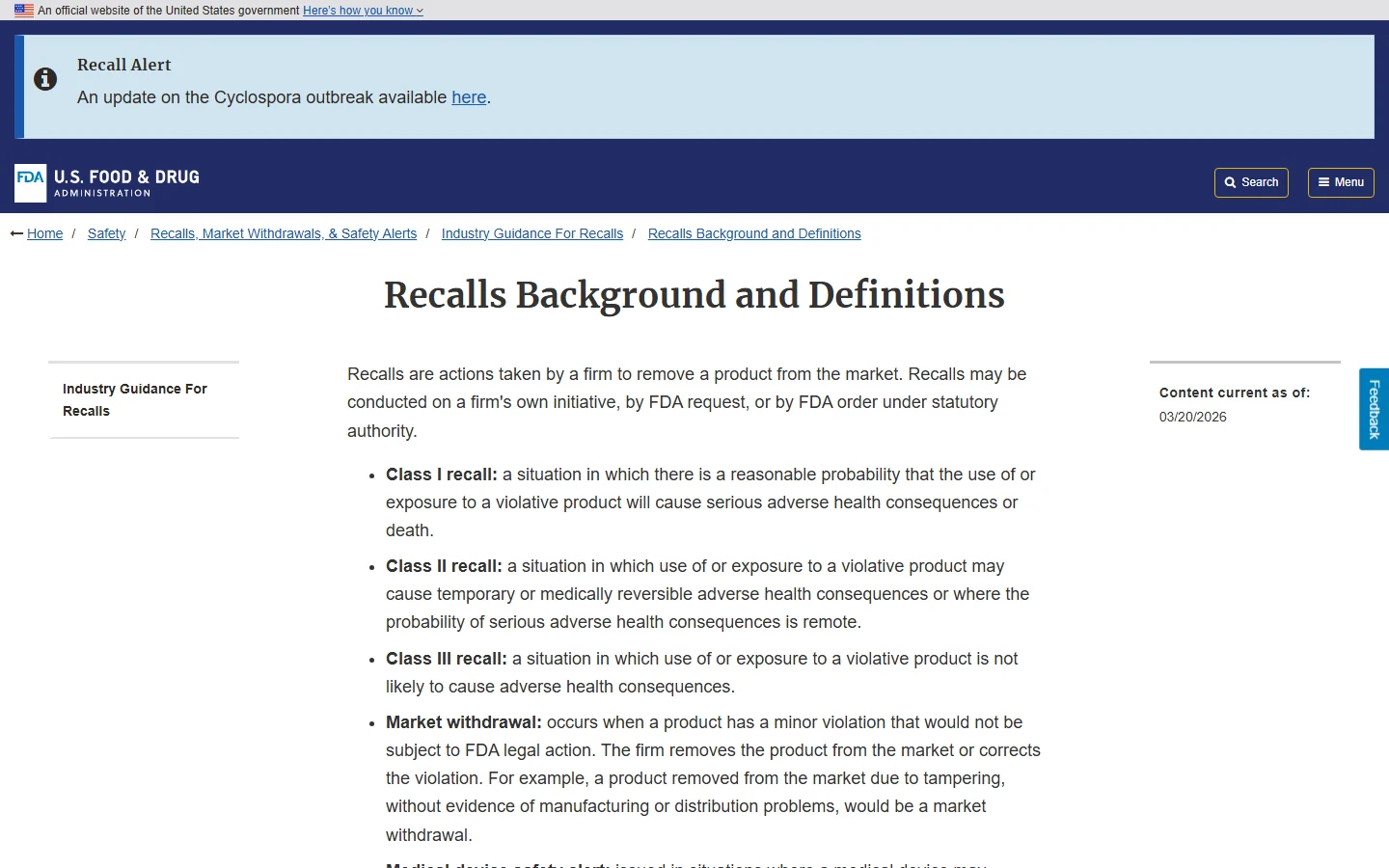
Reviewed July 27, 2026: FDA recall classes describe the relative health hazard of a specific recall. Class I is the most serious, Class II is intermediate, and Class III is the least likely to cause adverse health consequences. The class does not replace the product-specific notice: always match the exact product and follow the remedy or medical instructions in that notice.
FDA may post a recall as “not yet classified” while its health-hazard assessment is still underway. That wording does not mean the product is safe, and it should not delay action stated by the recalling firm or FDA.
FDA Class I vs Class II vs Class III at a glance
The formal definitions come from 21 CFR 7.3. This table pairs those standards with a consumer-oriented reading. “Violative product” means a product FDA considers to violate a law it administers and for which it could take legal action.
| FDA recall class | Regulatory health-hazard standard | Plain-language reading | First consumer step |
|---|---|---|---|
| Class I | Reasonable probability of serious adverse health consequences or death | The highest recall-hazard category; exposure may have severe or fatal consequences | Read and follow the notice immediately, including any urgent stop-use, return, disposal, or medical instructions |
| Class II | Temporary or medically reversible adverse consequences are possible, or the probability of serious consequences is remote | A real health risk remains, but the expected consequences or probability differ from Class I | Match the product and follow the recall instructions; do not interpret Class II as “safe” |
| Class III | Adverse health consequences are not likely | The lowest FDA recall-hazard category, often involving a violation with a low expected health impact | Still follow the correction, return, labeling, or other remedy in the official notice |
A useful memory aid is I = highest health hazard, III = lowest expected health hazard. This is only a ranking of the recall’s health hazard. It does not tell you whether your package, lot, model, or device is included, and it does not guarantee a refund.
What each FDA recall class means
Class I recall: reasonable probability of serious harm or death
A Class I recall meets FDA’s most serious threshold: there is a reasonable probability that using or being exposed to the violative product will cause serious adverse health consequences or death. “Reasonable probability” matters. The definition does not say that every exposed person will be injured, and it does not mean FDA has confirmed a death in every Class I event.
Consumer action can be urgent because the potential consequences are severe. The notice may tell people not to eat a food, stop using a consumer health product, contact a health professional, return a product, or take an interim precaution. Follow the exact language for that recall rather than applying a generic Class I rule to every product.
Class II recall: reversible effects or a remote probability of serious harm
A Class II recall covers two related situations. Exposure may cause temporary or medically reversible adverse health consequences, or the probability of serious adverse health consequences may be remote. Class II is therefore not a synonym for harmless, routine, or optional.
The response still depends on what was recalled. A food notice may direct disposal or return. A drug notice may tell patients to consult a pharmacist. A device correction may involve a software update, inspection, relabeling, or monitoring. Read the remedy and any risk-group guidance, especially when the notice identifies children, pregnant people, patients with a specific condition, or other susceptible groups.
Class III recall: adverse health consequences are not likely
A Class III recall is a situation in which use of or exposure to the violative product is not likely to cause adverse health consequences. FDA’s drug guidance gives minor labeling, packaging, or expiration-date concerns as possible examples, but the reason is specific to each event.
“Not likely” does not erase the violation or cancel the recall. A company may still need to retrieve stock, correct labeling, replace affected units, or give customers other instructions. The recall remains official even when the expected health impact is low.
How FDA decides a recall class
FDA does not classify a recall from the product name or headline alone. Under 21 CFR 7.41, an ad hoc committee of FDA scientists conducts a health-hazard evaluation and considers factors that include:
- whether disease or injury has already occurred;
- clinical conditions that could expose people or animals to the hazard;
- risk to different groups, including children, surgical patients, pets, and livestock;
- the seriousness of the health hazard;
- how likely the hazard is to occur; and
- immediate and long-range consequences.
FDA assigns Class I, II, or III based on that event-specific evaluation. Two recalls involving superficially similar products can receive different classifications when their defect, exposure route, dose, distribution, population at risk, or likely outcome differs. This is why readers should not predict a class from social-media descriptions.
The class is also separate from recall strategy. Strategy can address how deep the recall goes—such as wholesale, retail, or consumer level—whether a public warning is needed, and how the firm will check whether consignees received and acted on the notice.
What “not yet classified” means
A company often begins a voluntary removal or correction before FDA finishes the health-hazard classification. FDA’s Enforcement Report guidance says monitored recalls can appear as Class I, II, III, or “not yet classified.” FDA updates the entry after completing its assessment.
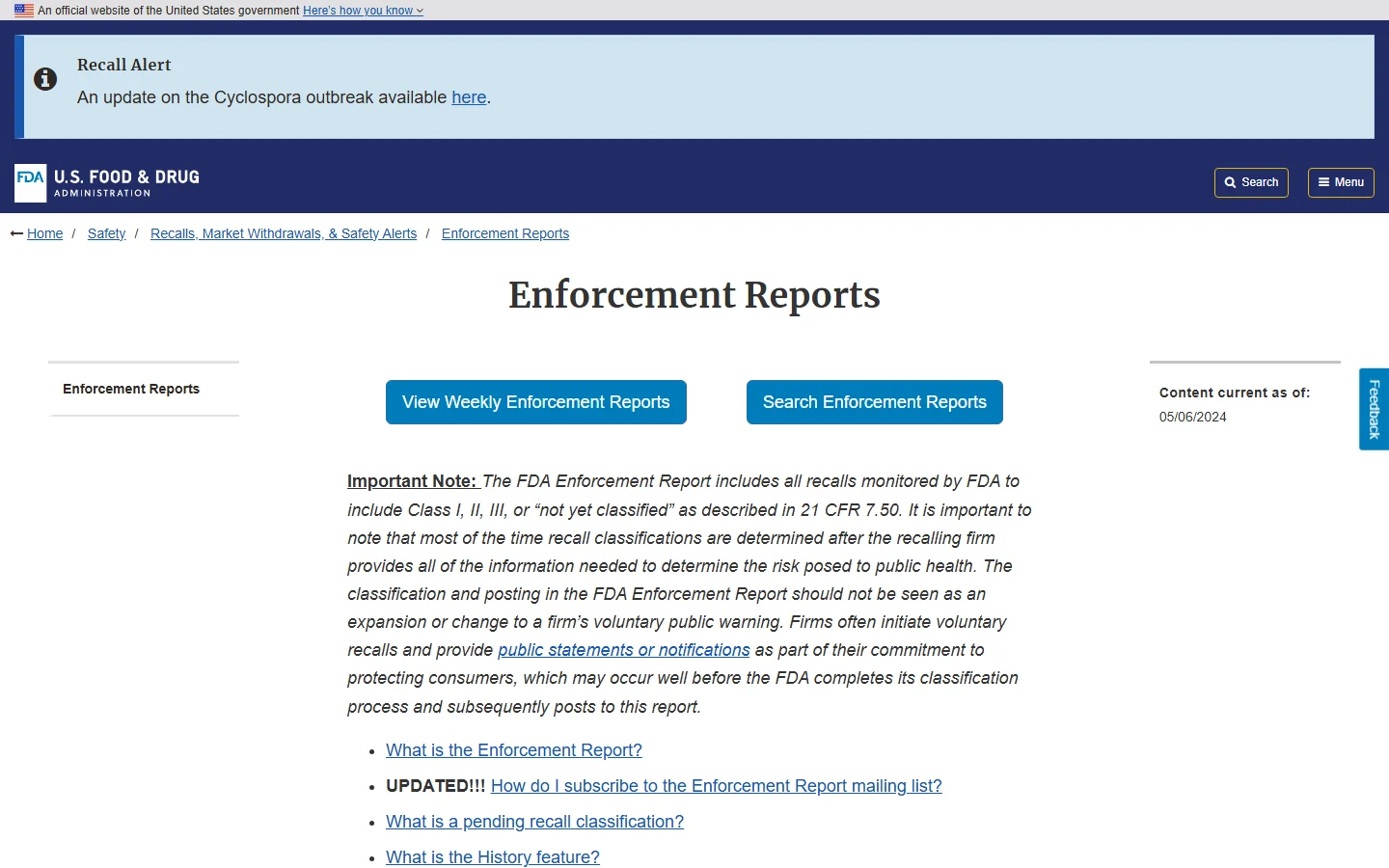
Pending classification is a timing status, not a finding of low risk. If the firm’s notice says not to use, eat, distribute, or sell an affected product, follow that instruction even while the classification field is pending. Later classification also should not be treated as an expansion of the company’s original warning unless an updated notice actually changes the scope or instructions.
The Enforcement Report’s history feature can show later changes to classification, reason for recall, code information, and product description for covered records. Recheck the official entry when a recall is developing.
What to do when your product is recalled
- Confirm the regulator. FDA covers most foods, drugs, medical devices, cosmetics, biologics, tobacco products, and animal or veterinary products. USDA FSIS, NHTSA, and CPSC cover other major categories.
- Match the exact item. Compare the brand, product name, size, UPC, lot or batch, expiration or use-by date, model, serial number, and distribution area named in the official notice.
- Read the reason and class together. The class summarizes relative health hazard; the reason explains the actual defect, contamination, labeling error, or other problem.
- Follow the event-specific instructions. The remedy may be disposal, return, refund, repair, relabeling, inspection, software correction, or patient monitoring.
- Preserve useful records. Photograph identifiers, keep the notice or recall number, save receipts when available, and record company or clinician guidance.
- Check for updates. Scope, code information, remedy availability, and classification can be updated.
You can start with Product Recall Checker, browse the latest recall records, or visit our consumer recall guides. Confirm a match and remedy with the linked government or recalling-firm source.
Special caution for recalled medicines and medical devices
Do not assume “recall” always means abruptly stopping a prescribed medicine. FDA’s drug-recall guide says stopping a medicine can sometimes be more harmful than continuing it. Match the lot number, follow the recall notice, and ask a doctor or pharmacist when instructions are unclear. For Class II and III drug recalls, FDA says patients can generally continue the medicine unless the recalling company or FDA directs otherwise.
A medical-device recall also does not always require returning a device or removing an implant. FDA explains that a device recall can involve inspection, repair, adjustment, relabeling, patient notification, or monitoring. A patient with an implanted device should discuss the risk of leaving it in place against the risk of removal with the treating clinician.
These cautions do not minimize a class. They recognize that the safest action depends on the product and the patient, not the Roman numeral alone.
How to verify the official FDA classification
- Open FDA’s Enforcement Report search.
- Search the exact product, recalling firm, recall number, or a distinctive lot/code term from the notice.
- Open the matching record and verify the product description, code information, reason, distribution, classification, and status.
- Compare those fields with the package or device in front of you. A shared brand name is not enough.
- Check the posted company announcement or product-specific FDA page for the current consumer instructions.
Not every recall receives broad news coverage or a standalone press announcement. FDA says all recalls it monitors are included in the Enforcement Report once classified, and some are posted there while still pending classification. The searchable record is therefore an important second check after a headline or retailer message.
For fast-moving food coverage, our weekly food recall guide shows how to preserve lot, date, and distribution details while linking back to FDA and USDA sources.
Do not confuse recall class with medical-device regulatory class
The same Roman numerals appear in two different FDA systems:
| System | What it describes | Direction of the scale |
|---|---|---|
| FDA recall classification | Relative health hazard of a particular recall | Class I is most serious; Class III is least likely to cause adverse health consequences |
| Medical-device regulatory classification | Level of regulatory controls needed to provide reasonable assurance of a device type’s safety and effectiveness | FDA says Class III has the most stringent controls; Class I has the least |
A Class III medical device can be involved in a Class I, II, or III recall, depending on the hazard in that recall. Likewise, the recall classification does not reclassify the underlying device type.
Recall, market withdrawal, stock recovery, and safety alert
These labels are not interchangeable. Under 21 CFR 7.3, a recall is a firm’s removal or correction of a marketed product that FDA considers violative and against which the agency could take legal action. A correction can occur without physically moving the product and may include repair, modification, relabeling, destruction, inspection, or patient monitoring.
- Market withdrawal: removal or correction involving a minor violation not subject to FDA legal action, or no violation, such as normal stock rotation.
- Stock recovery: removal or correction before the product has been marketed or left the firm’s direct control.
- Medical-device safety alert: a notice about a device that may present an unreasonable risk of substantial harm; some safety-alert situations also qualify as recalls.
Do not assign Class I, II, or III to a market withdrawal merely because the situation sounds serious. Classification belongs to an FDA recall record.
FDA recall class FAQ
Is every FDA recall classified immediately?
No. A firm can initiate and announce a recall before FDA completes its health-hazard assessment. The Enforcement Report may display “not yet classified” and later update the entry.
Is a Class II recall safe to ignore?
No. Class II means temporary or medically reversible adverse consequences may occur, or the probability of serious consequences is remote. Follow the notice and check whether your exact item is included.
Does Class III mean the product is legal to keep selling?
No. Class III still describes a recall of a violative product. It means adverse health consequences are not likely, not that the violation has disappeared.
Does the recall class determine whether I receive a refund?
No. The class describes health hazard. The recalling firm’s remedy determines whether consumers should return, discard, repair, exchange, relabel, or seek a refund.
Can an FDA recall classification change?
An entry may move from “not yet classified” to Class I, II, or III after FDA completes its assessment. FDA’s Enforcement Report history can also display later classification updates for covered records.
Is Product Recall Checker an FDA service?
No. Product Recall Checker is an independent consumer information site. FDA and the relevant product-specific notice remain the authoritative sources for classification, scope, and remedy.
Official sources
- FDA: Recalls Background and Definitions
- 21 CFR 7.3: Definitions
- 21 CFR 7.41: Health Hazard Evaluation and Recall Classification
- FDA Enforcement Reports guidance
- FDA: Medical-Device Regulatory Controls
Editorial note: This explainer summarizes federal definitions and consumer guidance reviewed on July 27, 2026. It is not medical advice and does not classify any specific recall.
Comments
Comments are reviewed before publication. Do not post personal information, serial numbers, medical details, or emergency reports. For urgent safety concerns, use the official agency contact in the recall notice.
Sign in with Google to leave a comment
Loading comments...