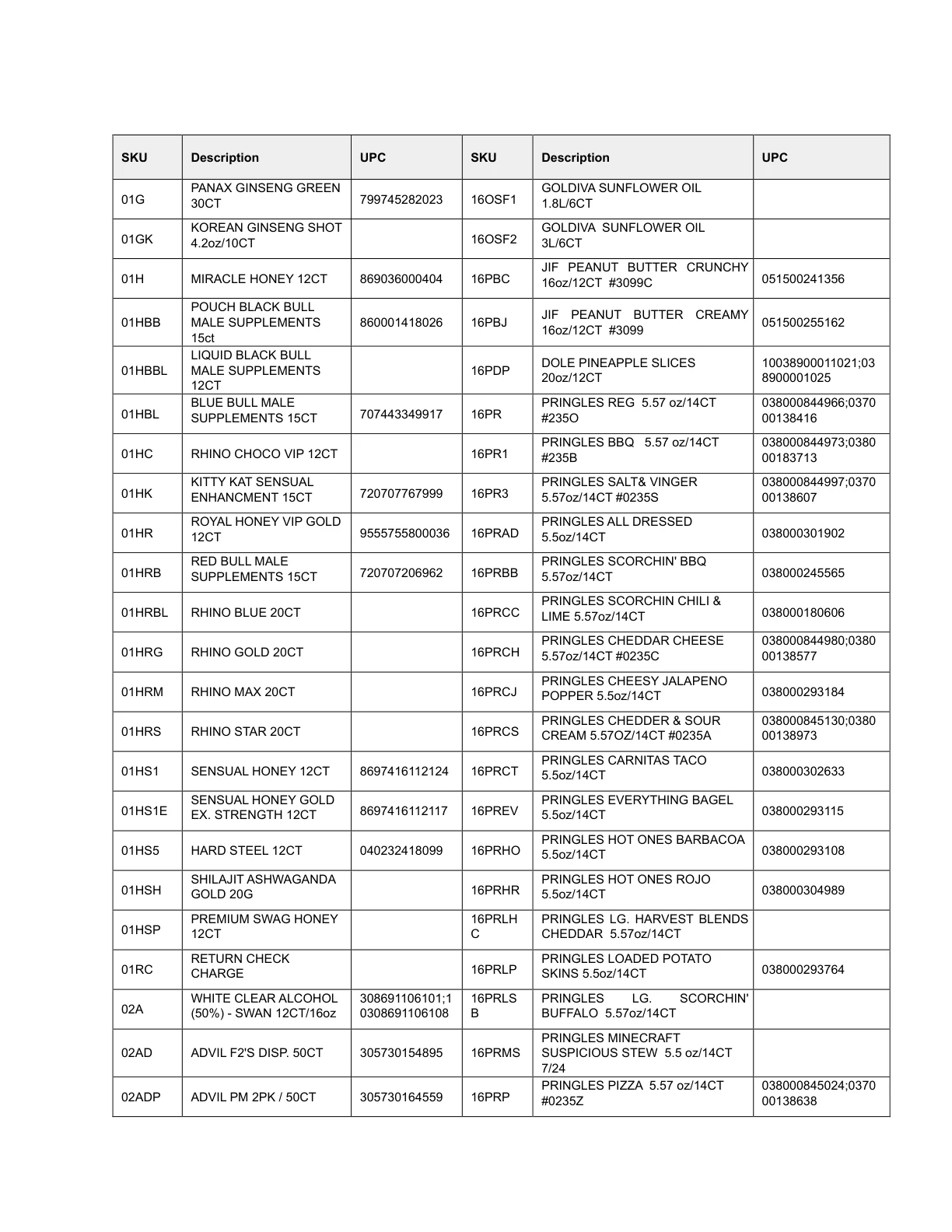
The Gold Star Distribution recall list is a warehouse and distribution recall announced December 26, 2025. To check a purchase, use both the FDA product attachment and the named store's address, then establish whether the item came through Gold Star. Finding Cheerios, Pringles or Gatorade in the attachment does not mean every package of that brand nationwide was recalled.
This guide was checked October 9, 2026. Keep the package, barcode and purchase information available while you verify it. Product Recall Checker is an independent website; the official announcement, its attachment and the company's confirmed instructions determine the affected scope and remedy. A product with an uncertain distribution history needs further checking rather than a guess based on the logo.
What the Gold Star recall covers
The FDA-hosted Gold Star announcement identifies a storage problem at the distributor's facility: rodent and bird contamination and insanitary conditions. It includes listed FDA-regulated human food, pet food, drugs, devices, cosmetics and dietary supplements. The controlling connection is the warehouse, not a claim that the factories making all those brands produced defective goods.
That distinction changes the way you investigate an item. A familiar brand and matching barcode identify a type of product; they do not prove its route from manufacturer to retailer. For this event, ask the selling store or distributor about the source of your purchase. A bottle or box obtained through another supply chain cannot be added to the Gold Star scope solely because its brand appears in a news headline.
| Question | What the notice establishes | What still needs checking |
|---|---|---|
| When was it announced? | December 26, 2025 | Any subsequent notice or company instruction |
| Which products? | The listed FDA-regulated products held at the facility | Your exact product and distribution history |
| Is there one universal batch code? | The public product attachment gives SKU, description and UPC fields | Do not invent a batch range missing from the source |
| What is excluded? | Products shipped directly to stores, including the described frozen and refrigerated direct shipments | The actual shipment route, rather than temperature alone |
Before checking individual brands, divide your household's purchases into three groups: documented matches, items with incomplete records, and purchases whose verified source falls outside this particular action. Keep the middle group open until the retailer answers the distribution question. This simple working list prevents a missing receipt from silently becoming a negative result.
Record the date of your check beside each item. Also save the exact source link, because a screenshot shared without its surrounding announcement can lose the exclusions that define the recall. If someone sends you a list headed “rodent waste recall,” request the original attachment rather than relying on a cropped social-media image. The same descriptive phrase can appear in coverage of unrelated warehouse problems, and a search result alone is not enough to connect your package to this event.
Find your product in the FDA attachment
Open the full FDA product attachment rather than an abbreviated brand list. Use the PDF reader's search function for your product name, then repeat the search with the barcode. Search more than one spelling when necessary, because the inventory uses shortened descriptions. Read the entire row and note its page number so you can discuss the same entry with the retailer.
Keep your package alongside the screen. Start with product identity, flavor or formulation, and individual container size. Then compare the UPC and ask about distribution. If a row has no barcode, the absence is a missing identifier in the attachment; it is not an exclusion. Save a photo of the label and ask Gold Star or the selling business to help interpret the row instead of substituting a barcode from an online store.
Cheerios, Pringles and Gatorade examples
| Example description in attachment | Listed UPC | Location |
|---|---|---|
| Cheerios Cereal, 14/12 oz, #66610 | 016000487727 | PDF page 36 |
| Pringles All Dressed, 5.5 oz/14 CT | 038000301902 | PDF page 1 |
| Gatorade Blue Cherry, 15/28 oz | 052000104103 | PDF page 16 |
These examples show how to locate a row; they are not a replacement for the complete attachment. Check other flavors, sizes and products directly. In particular, the Gatorade entry here belongs to the Gold Star warehouse action. Do not combine its distribution scope with a different Gatorade recall or borrow a lot range from another notice. Matching a brand across two events does not make their causes or affected packages interchangeable.
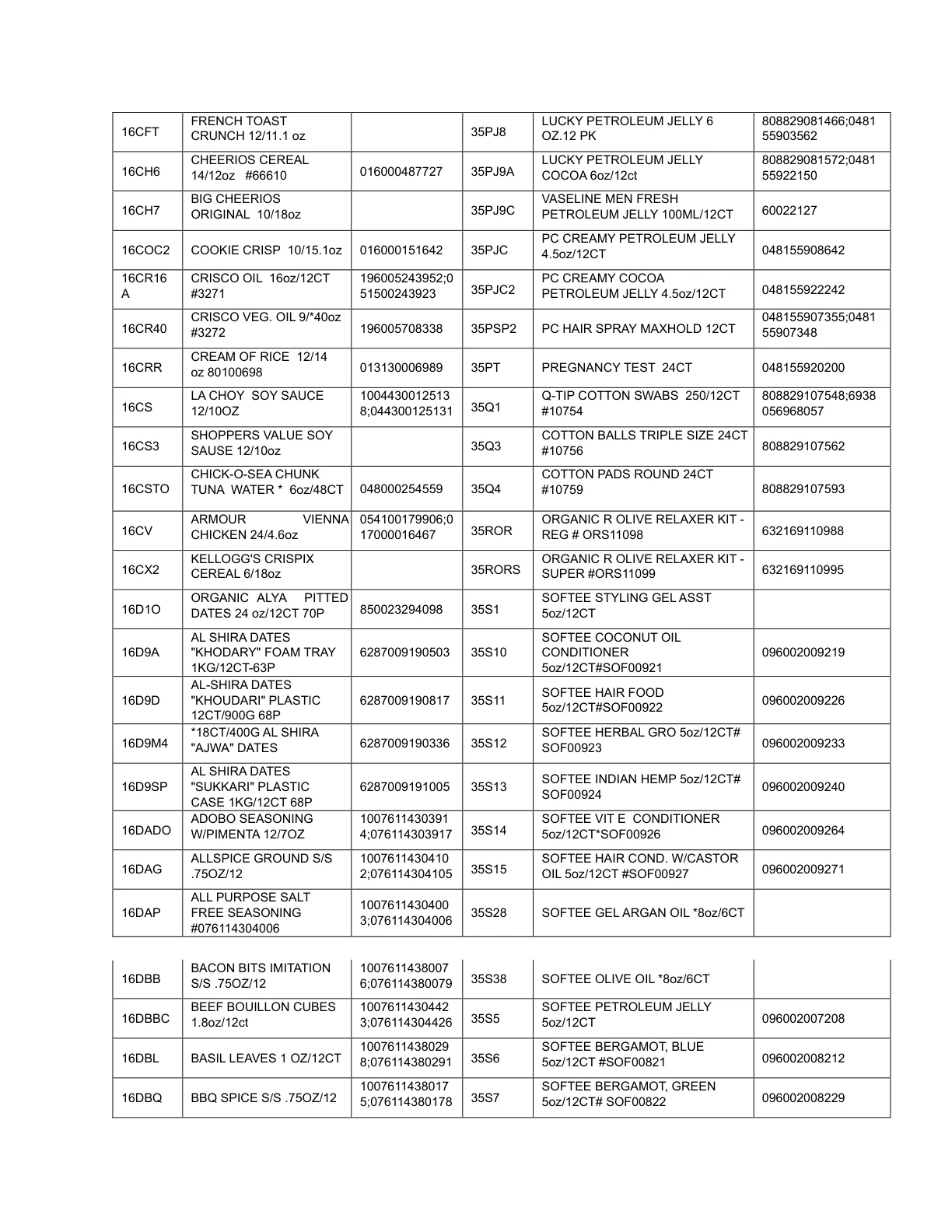
Read UPCs, sizes and distributor SKUs correctly
The attachment places two sets of SKU, description and UPC columns next to each other. A value in the right-hand set belongs to that set's product, not to the left-hand description. Distributor SKUs help the company locate inventory, but they are a separate field from the consumer barcode. Retain leading zeros and check visually when digits wrap onto another line.
Case-style descriptions can also be confusing. A description such as 14/12 oz combines a case quantity with a container size; it is not the wording you necessarily see on a single cereal box. Write down both the attachment's complete description and your package's wording. Where the two do not obviously align, ask the seller to explain the case-to-unit relationship. An unresolved mismatch deserves a specific question, not an edited number that makes the row appear to fit.
Check the store and distribution route
The FDA announcement provides a table of selling businesses with street addresses and cities. Use that full table to look up where you bought the item. For example, it names AIMMART International Market at 1435 W. 86th St., Indianapolis, and Fargo Halal Market at 855 45th Street S., Fargo, alongside Minnesota locations. These are specific addresses, not instructions to treat every grocery purchase in three states as affected.
Find the exact location even if you recognize the store's name. Two businesses can have similar names, and a merchant may operate more than one location. Copy the address from your receipt or order record and compare it with the announcement. If you purchased through delivery, identify the store that fulfilled the order; the delivery service's name does not establish the supplier that handled the goods.
The notice describes distribution to some or all of the listed stores. Therefore, a named store is a reason to investigate an identified product, not proof that every item sold there came through Gold Star. Ask the store which supplier provided the particular item and whether it can connect the relevant shipment to its recalled inventory. Do not replace this question with a general inquiry about whether the business sells the brand.
When the purchase record is incomplete
Prepare a short request containing the product description, package size, UPC, any remaining date codes, the approximate purchase date and store address. Explain that you are checking the December 26, 2025 Gold Star recall. A precise request gives staff a better chance of reviewing the correct inventory records than a question about “the cereal recall” without a flavor or size.
If you cannot find a receipt, check a grocery account, order confirmation or transaction history for the merchant and date. Those records can establish where you shopped even when they do not identify every product. Say what you know and what is missing. An account order can document a purchase, but it cannot by itself prove the warehouse route.
Keep a written note of the response, including who answered and which product they checked. If the seller cannot resolve the source, contact Gold Star through the channel in the FDA consumer bulletin. Avoid treating an unanswered telephone call, a broken PDF link or a barcode search with no results as confirmation that your package was unaffected. Each means that the check remains incomplete.
Disposal, refunds and contacting Gold Star
The FDA bulletin directs consumers and retailers with affected products to destroy them and verify destruction with a receipt provided to Gold Star. It also says not to ship the products back. Treat that instruction separately from the company's mailing address: an address for documentation is not permission to send contaminated merchandise there.
The announcement says refunds are available upon request. That supports contacting Gold Star about the remedy; it does not establish an automatic payment, a universal refund at every retailer, or a published processing deadline. Ask the company how it wants the destruction receipt documented, what supporting purchase information it needs, and how to submit the request. Avoid inventing a claim form or relying on an unrelated retailer's return policy.
- Confirm the product and distribution connection using the official material.
- Read the notice's disposal instructions and obtain clarification for a product requiring special handling.
- Record identifying information without unnecessary handling or opening the package.
- Ask Gold Star about acceptable documentation and the refund request procedure.
- Keep a copy of the request and any response, without shipping the affected product back.
The consumer telephone printed in the announcement is 612-617-9800. Its listed hours are seven days a week, 8 a.m. to 5 p.m., Central Standard Time. These are the published contact details, not a promise that a call will be answered immediately today. Identify the December 2025 warehouse recall when calling so the conversation is about this action rather than another brand's refund program.
For documentation, the notice identifies Gold Star at 1000 N. Humboldt Ave., Minneapolis, MN 55411. Verify the submission method directly before sending personal or purchase records. If someone offers a different refund link in a message, compare it with the official contact channel first. Keep the product decision and the payment request separate: lack of an instant refund response does not change the notice's instructions for an affected item.
If your item is a medicine or device used for ongoing care, ask your pharmacist or treating professional how to replace or handle it while maintaining needed treatment. The recall's general destruction instruction is not an individualized plan for interrupting care. Supply the exact package information so the professional can check the affected purchase and appropriate alternative.
Food, pet food and medical-product concerns
A mixed-product recall requires more than one response pathway. Checking cereal in a pantry, dog food in a cupboard and a medicine used for continuing treatment are different tasks even when the items share a distributor. Start by identifying the affected purchase, then use the relevant professional or reporting channel. Do not assume that an instruction appropriate for a snack solves a medical-device question.
The FDA's reporting guidance distinguishes receiving health care from submitting a complaint. Its complaint and MedWatch systems record product problems; they do not provide medical advice. If a person has a health concern related to using an affected item, contact a health professional first and use the agency reporting process for the product information.
If somebody has already used the product
Tell the professional which product was used, when, how much identifying information remains, and what problem you observed. Include the store and any confirmation linking the item to Gold Star. Do not state that the recall caused an illness merely because the dates overlap. Your observations and the official recall details are useful evidence, while diagnosis and causal assessment require professional evaluation.
For an animal that ate affected pet food, contact a veterinarian. The FDA pet-food complaint guide explains how product information and the animal's experience help its monitoring work. Keep the brand, food type, packaging details and purchase source available. If the concern is a product problem without illness, describe that accurately rather than adding a symptom to make the report seem more urgent.
Keep treatment decisions with a health professional
For an affected medicine, contact the dispensing pharmacy or prescriber about the exact item and an appropriate replacement. For a device supporting ongoing care, contact the treating team or device supplier. Do not independently stop necessary treatment, change a dose or substitute a superficially similar product. A warehouse recall gives a reason to resolve the affected supply; it is not a personalized treatment plan.
Keep copies of the package information and relevant notice for that discussion. A medical product's formulation, strength or device identifier can matter beyond the brand name used in a headline. The FDA drug-recall guidance is a useful starting point, but the next practical decision belongs with the professional who understands the patient's care. Refund paperwork should not displace that conversation.
Why 2025 recall notices still appear in 2026 searches
Search results can show several dates for the same underlying problem. The Gold Star company announcement began in December 2025, while reporting, database posting and later enforcement activity continued into 2026. A recent news date is a reason to read the new development; it does not automatically establish that a new batch of a nationally distributed brand has just been recalled.
| Date | Official development | How to interpret it |
|---|---|---|
| December 26, 2025 | Company recall announcement hosted by FDA | Starting notice for affected products, stores and remedy |
| September 21, 2026 | Court approved entry of a consent decree | Enforcement action addressing warehouse operations |
| September 23, 2026 | FDA published its enforcement news release | Publication of the later development, not a replacement product attachment |
The FDA September news release explains restrictions on the company's receiving, holding and distributing FDA-regulated products until it meets the required conditions. The court's September 21 order supplies the corresponding procedural date. These documents help explain continued attention to Gold Star, but they should not be turned into a new nationwide Cheerios or Pringles consumer list.
Likewise, do not infer recall status from whether a headline remains searchable. The FDA's public recall index explains its terminated-recall terminology and directs readers to fuller recall information. A retained company announcement and the current enforcement status are different pieces of evidence. When status matters to a purchase or remedy question, check the relevant official record and company guidance rather than treating the article's year as a status label.
You can use our 2026 food recall archive to find other dated events or latest recall records to begin a broader search. Keep each event's scope separate when reviewing the results. For Gold Star, the practical sequence remains product row, exact selling location, distribution connection and verified consumer instruction. That sequence works even when the story's most recent headline discusses a court order rather than a newly recalled package.
Comments
Comments are reviewed before publication. Do not post personal information, serial numbers, medical details, or emergency reports. For urgent safety concerns, use the official agency contact in the recall notice.
Sign in with Google to leave a comment
Loading comments...