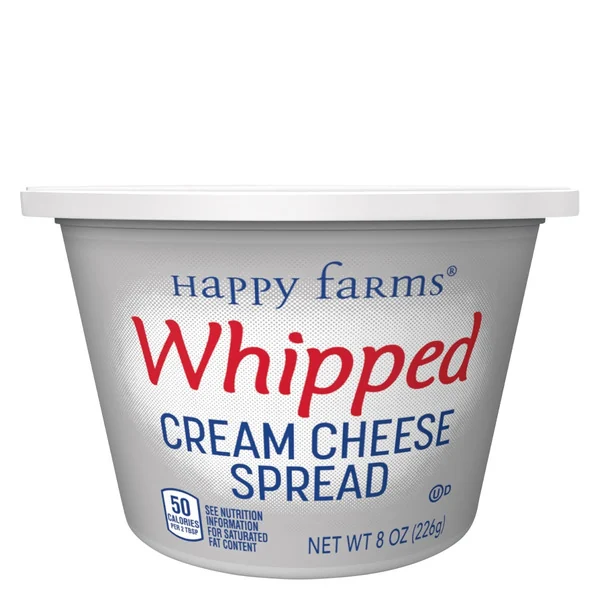
The Happy Farms cream cheese recall discussed here is a May 2024 notice, not evidence of a newly announced 2026 recall. Check the exact spread, eight-ounce cup, UPC and listed 2024 sell-by date. Searches containing “today” or “2026” can still surface that older event. This guide was checked on October 9, 2026 and explains how to verify the date and product before acting.
Use ALDI's current recall page to investigate a new purchase or new message. Product Recall Checker is an independent site, and the original retailer or government notice controls the affected scope and instructions.
Is the Happy Farms cream cheese headline a new 2026 recall?
The official Happy Farms spread announcement commonly returned by these searches belongs to 2024. The ALDI notice preserved by an Indiana government health site is dated May 9, 2024 and concerns potential Salmonella contamination in four eight-ounce spreads. Its identifying sell-by dates are in August and September 2024. Those dates should remain attached to the event whenever an old headline is shared.
In our October 9, 2026 check of ALDI's official U.S. recall index, we did not find a new matching 2026 announcement for those four cream cheese spreads. That is a description of the source check, not a guarantee about every ALDI dairy product or future notice. Other cheese entries on the index must be investigated on their own terms.
Two different date labels may appear while looking up the historical notice. ALDI's index places the entry under May 7, 2024, while the document itself is dated May 9. Record both accurately if you are tracing a shared link. Neither date supports relabeling it as a new event in 2026 simply because the index remains online or a search result was crawled recently.
For a recently bought tub, compare its current identifiers with a current notice rather than using an old warning as a brand-wide rule. For a historical purchase question, use the 2024 table and purchase record. These are different tasks. A person looking for reimbursement information about an old purchase may need the historical instructions even though a person choosing today's groceries needs a new product-specific check.
Also distinguish what the notice says from what it does not report. “Potential Salmonella” is its stated reason. It is not a statement that every Happy Farms dairy product tested positive, nor does it identify a Listeria event. This guide does not add an illness count or an official recall-termination status that was not provided in the ALDI document. The exact products and printed dates offer a firmer basis for verification than a recycled warning without its year.
The products and dates in the May 2024 ALDI notice
The document linked from ALDI's current index lists four Happy Farms spreads, each in an eight-ounce cup. It supplies UPCs and individual sell-by dates. The table below preserves those discrete dates; it does not turn the earliest and latest dates into a continuous range.
Regular and whipped spreads
| Spread | UPC | Listed sell-by dates |
|---|---|---|
| Cream Cheese Spread | 4099100101737 | 09/01/2024; 09/08/2024; 09/15/2024 |
| Whipped Cream Cheese Spread | 4099100101881 | 08/30/2024; 08/31/2024; 09/01/2024; 09/03/2024; 09/04/2024 |
Plain spread and whipped spread have different UPCs and different date lists. A regular spread with a September date should be compared with the regular row, not with every September date mentioned anywhere in the notice. The eight-ounce cup description matters too: the table does not identify an unrelated boxed cream cheese product or another package size merely by using a familiar brand.
For a historical purchase check, record the complete date including 2024. A receipt showing a product name can help establish that you bought a spread, but it may not establish which dated cup you received. If you have a saved photograph, compare the front name, volume, barcode and date together. Do not fill a missing package date with the day you purchased it.
Strawberry and chive and onion spreads
| Spread | UPC | Listed sell-by dates |
|---|---|---|
| Strawberry Cream Cheese Spread | 4099100101744 | 09/08/2024; 09/15/2024 |
| Chive & Onion Cream Cheese Spread | 4099100101751 | 09/13/2024; 09/22/2024 |
These flavored products remain separate entries. Strawberry shares two dates with the regular spread, but the two UPCs are different. Chive and onion has its own dates. Keeping the rows intact avoids an easy mistake: copying all dates from a summary and attaching them to every Happy Farms flavor.
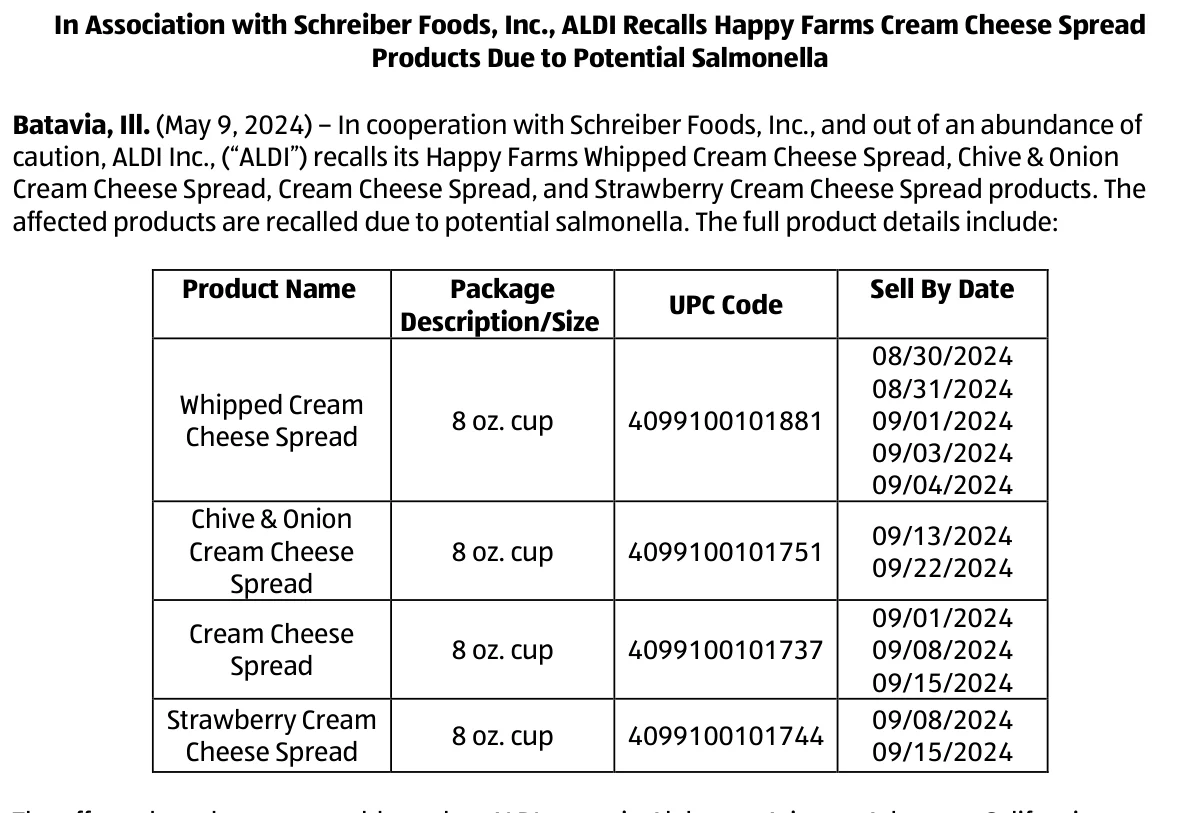
The ALDI consumer document does not provide a separate lot number for this table. Do not create one by copying a warehouse code from a broader supplier report. The available consumer-facing fields are the product, cup size, UPC and sell-by date. If an old record lacks one of those fields, describe that limitation honestly when asking ALDI or Schreiber for help.
How to verify the tub or purchase record you have
FDA's consumer food-recall guide explains the identifying information used in notices: product names, packaging, UPCs, codes, dates and distribution details. Apply that complete approach rather than treating “Happy Farms” as a decision by itself. A front-label photograph can establish a flavor, while a separate date or barcode photograph may be needed to finish the comparison.
Match a specific flavor to its own identifiers
Start with the product type. The historical list says spread in an eight-ounce cup. Then choose the exact flavor row and compare its UPC. Finally, compare the complete printed sell-by date with that row's individual dates. For example, 09/13/2024 belongs to the chive and onion row; it does not become a recalled strawberry date merely because both spreads appear in the same announcement.
Keep purchase location in your record. The official notice says the products were sold at select ALDI stores in its listed states and the District of Columbia. A state list is distribution context, not proof that every store carried every affected cup. If your question involves a specific historical transaction and you cannot verify the date, explain that limitation to the retailer or company rather than labeling it a confirmed match.
When reviewing a receipt, distinguish the transaction date from the product's sell-by date. The receipt may confirm that a spread was bought, but it usually does not reproduce the cup's printed identifier. A later online product listing shows what the retailer displays at that time, not necessarily the package sent in an older order. Saved original photographs or packaging records provide stronger evidence for the matching fields.
If someone forwards you a tub picture, ask whether it is their actual item, a catalog photograph or an image lifted from a notice. Those images serve different purposes. A catalog picture helps recognize the product family; it cannot establish the lot or date of a cup in your refrigerator. Similarly, an official recall table is a reference, not evidence that your purchase came from an affected run.
For a newly purchased tub whose identifiers differ from the 2024 table, investigate the current ALDI notice page and any new product-specific alert. Do not stretch the historical dates to cover a current year. An unclear or missing identifier should remain an unanswered question until the retailer or manufacturer can assist, rather than being turned into either a confirmed recall or a guarantee that the product is unaffected.
Do not confuse cream cheese with other cheese notices
“ALDI cheese recall” describes a search topic, not one universal recall. The retailer sells different cheese types under different labels, and the same broad word can retrieve spread, shredded, sliced and soft-ripened products. Identify the actual product before deciding which notice answers your question. The four cream cheese spreads in this guide cannot be used as a shortcut for another cheese category.
A concrete historical comparison is the 2024 Savencia soft-ripened cheese notice, which includes an ALDI Emporium Selection Brie entry and concerns potential Listeria contamination. That is distinct from Happy Farms cream cheese spreads and their potential Salmonella notice. The different brand, cheese type, supplier, dates and hazard identify separate events; a shared retailer does not merge them.
Use a five-field comparison when two headlines seem similar. Write the complete product name, recalling company, notice year, stated hazard and consumer-facing identifiers for each. If one field differs, investigate the notices separately. This is especially helpful when a news story discusses several retailers or suppliers: its general introduction may cover a wider situation than the one product row relevant to your purchase.
Another common source of confusion is the year printed on the food. A product with a 2026 sell-by date can appear in a notice issued in 2025. That printed year does not establish a recall-initiation date. For the Happy Farms spread notice here, both the document year and identifying sell-by years are 2024; neither should be replaced by the current calendar year to make the article seem newer.
Check geography as well. ALDI operates in more than one country, but this guide concerns its U.S. notice. A foreign government announcement about an ALDI product needs its own country, package and distribution check. Do not substitute a foreign package weight or a different regional brand for the U.S. cup table.
The general ALDI recall guide is useful for finding different product families. Once you find a likely notice, return to that notice's exact row rather than transferring cream cheese dates to a shredded blend or Brie. A precise product decision depends on the specific event, even when a search page groups several results under one familiar supermarket name.
What the original notice told customers to do
The historical ALDI notice advised people with affected products to discard them immediately or return them to their local store for a full refund. It directed questions to Schreiber Foods at 1-800-644-5473 or [email protected]. Those instructions belong to the identified 2024 spreads. They should not be presented as a newly announced 2026 refund offer for all Happy Farms purchases.
If you are resolving an old purchase or an old claim, contact the retailer or Schreiber with the original product information and ask how the historical instruction applies now. This guide does not establish a current claim deadline, a receipt waiver or compensation for related expenses. An official refund sentence in an old notice is not enough to invent those additional terms.
For any actual matching product, do not taste it to decide whether to follow the instruction. Keep it separate from food others may use while arranging the next step. If you need a record, photograph the identifying label and date without opening or spreading the contents. Follow the notice's disposal or return route; do not redistribute it to another household as an alternative.
Practical questions should be specific. Explain whether you still have the cup, only a photograph or only a receipt, and list the exact fields you can verify. “I bought Happy Farms” is less useful than the flavor, UPC, sell-by date and purchase location. Let the company resolve missing information rather than converting an incomplete record into a confirmed affected purchase.
If you are concerned about illness after eating a product
CDC's Salmonella symptoms page describes diarrhea, fever and stomach cramps, with symptoms usually beginning six hours to six days after infection. It advises contacting a doctor for warning signs such as bloody diarrhea, fever above 102°F, dehydration or prolonged vomiting or diarrhea. These are clinical reasons to seek advice; they do not establish that a particular cream cheese purchase caused the illness.
Tell a healthcare professional the product and exposure timing if you think food may be involved. A current illness after a recent purchase needs appropriate care and a current product investigation, rather than an assumption that a 2024 notice explains it. Do not delay medical attention while trying to reconstruct a receipt, and do not self-prescribe a treatment from a recall article or forum discussion.
How to check an ALDI cream cheese alert today
Open ALDI's current U.S. recall page and look at the year grouping before opening a cream cheese entry. Read the document date, full product name and identifiers. If a forwarded message claims a new event, it should lead to a new or revised official notice that actually describes the product; an old article with a recent search crawl date does not supply that evidence.
For this historical event, the useful search fields remain Happy Farms, the exact spread flavor, the eight-ounce cup and its UPC. Add the printed sell-by date when available. Searching those details helps distinguish the 2024 cream cheese notice from another ALDI dairy product or a different country's announcement. Do not put “2026” into an old date field simply because that is the year you are checking.
If an old PDF address fails, return to the retailer's index and open its current link. Websites sometimes move documents; a broken old address does not establish that a notice was withdrawn. Keep a government-preserved copy as historical reference, while using the latest retailer instructions to resolve present questions.
You can also consult FDA Enforcement Reports for regulatory records. FDA explains that a later classification or posting should not automatically be interpreted as a new expansion of a company's voluntary warning. Compare the actual product and code changes, not only the most recent date displayed by a search engine.
Save a short outcome: the official link checked, the date, the exact product row and whether your information fully matched, partly matched or remained unclear. That record is useful when another household member asks what to do. A partial record merits a company question, while a confirmed matching notice supplies the next action.
For other ALDI purchases, use the ALDI recall guide, Product Recall Checker search or latest records to find the appropriate source. Finish with the official product-specific notice. This keeps the historical Happy Farms information useful without turning a 2024 event into an unsupported warning about every cream cheese cup sold today.
Comments
Comments are reviewed before publication. Do not post personal information, serial numbers, medical details, or emergency reports. For urgent safety concerns, use the official agency contact in the recall notice.
Sign in with Google to leave a comment
Loading comments...