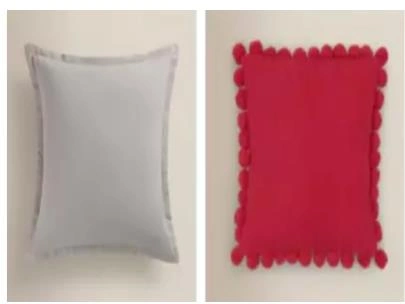
Updated November 10, 2026. The George Home cushion recall is identified by OPSS reference 2512-0177. Check the product description, barcode and applicable batch condition in its official Annex A against the cushion you own. If it matches, the official instruction is to stop using it immediately and return it for a full refund. This guide concerns the notice published on December 17, 2025, not a newly announced 2026 recall.
Check the notice before using the cushion again
The OPSS notice for George Home Cushions sold by Asda describes square cushions in various colors, with a sales period from January 2023 to December 2025. It directs readers to Annex A for the full identifiers. The sales period helps establish context, but it does not replace the actual product and batch comparison.
Confirm the reference number before opening a downloaded report. Search results also return a separate George Home square seat-pad notice. Similar terms and photographs can lead to the wrong document, even when the retailer and reported hazard are the same. A barcode table from another notice is not an alternative way to check these cushions.
The stated concern is that the filling may not be fire-retardant. Do not continue using a matching cushion while treating this as a routine quality or appearance question. Equally, do not broaden the announcement into a claim that every George furnishing is recalled. The document's identifiers define what is included.
Keep the cushion's existing labels available for a careful comparison. The following sections explain the annex and label photographs without asking you to open the filling or perform a test. If you cannot establish the required markings, keep that uncertainty explicit and ask the retailer for help rather than inventing a code or assuming the product is unaffected.
Read Annex A by product, barcode and batch
Open the official 2512-0177 report and continue to Annex A on the second page. It supplies the product names, batch conditions and barcode values. Keep those three columns together when comparing an item. The table below reproduces the seven rows in that annex; it does not add products from a separate seat-pad notice or a shortened news list.
Start with the description and barcode
| Product name in Annex A | Affected batch codes | Barcode as printed in the PDF |
|---|---|---|
| Solid dye cushion green | 242, 243, 244, 245, 246, 24x, 24y, 251, 252, 257 | 506308923954 |
| Solid dye cushion grey | 253, 254, 258 | 506308923952 |
| Solid dye cushion natural | 242, 243, 244, 246, 24x, 24y, 251, 252, 253, 258 | 506308923953 |
| Slub pom pom edge cushion natural | 244, 245, 24x, 24y, 251, 252, 254 | 506308952358 |
| Solid dye cushion orange | 254 | 506308993599 |
| Quilted stripe cushion | All | 506308993609 |
| Textured diamond cushion | All | 506308993610 |
These barcode entries are printed as twelve-digit values in the official PDF. They are reproduced unchanged here. Do not append an assumed check digit, shorten the number on your label or insert a zero to force agreement. If the label you can read uses a different length or format, preserve both references and ask Asda to clarify the comparison.
Use the whole description, not just “green” or “natural.” A furnishing's appearance can help locate the relevant row, but it does not establish the identifying number. Several cushions may look similar in a living room or an online photograph while belonging to different products.
Keep each row's batch condition with that row
Once the description and barcode have been identified, read that row's batch condition. The green solid-dye row and the grey solid-dye row do not list the same batches. Copying a code from the neighboring row can therefore change the result. Work across the table rather than collecting every batch number into one brand-wide list.
The word “All” appears for the quilted stripe and textured diamond entries. It applies to those specified product rows; it does not say every batch of every George cushion is included. Conversely, do not add a batch restriction to one of those rows because another design has a shorter list.
Record a comparison for each cushion separately. If one item is unreadable, leave it unresolved while completing the checks you can make on the others. Neither a matching cushion elsewhere in the house nor a missing number on one label establishes the status of the remaining items.
Find the two markings shown in the official photographs
The official report illustrates the product and its labels, including a separate ticket printed with the example batch number 252. Use those photographs to understand what information to look for, then read the markings on your own cushion. An example label does not establish the batch of every cushion shown alongside it.
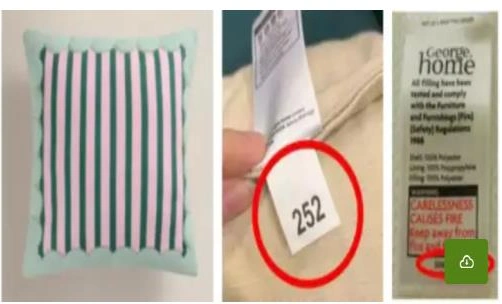
Keep the product description, barcode and batch as separate entries. Identify the visible label information without cutting a seam or removing filling. If more than one label or ticket is attached, photograph the markings separately and keep a wider view showing the item they belong to. This reduces the chance of mixing a batch from one cushion with a barcode from another.
Do not try to reconstruct a full barcode from the small label photograph in the notice. Some of that print is not sufficiently clear for a reliable digit-by-digit comparison. The written Annex A and the readable label on the actual item are the better references; a blurred image is not a reason to guess a missing digit.
Copy letters and digits without changing the code
Annex A includes 24x and 24y in several batch lists. Preserve those lettered entries as printed instead of silently replacing them with numbers that look similar. Likewise, copy a code you can read on the cushion before comparing it with the list. Do not make the observed value fit the expected answer.
If part of a marking is unclear, record only what is visible and state which character cannot be distinguished. A fresh photograph with better lighting may help document the existing print, but it does not justify enhancing or retyping it into a claimed match. Ask the retailer about a remaining discrepancy rather than treating an uncertain character as confirmed.
The product photographs are illustrations, not extra rows in the recall table. Their colors or arrangement cannot broaden the written scope. Work back to the identified design and its specific batch condition, especially where the report's example photographs contain several separate items and labels.
Understand the fire warning without testing the filling
OPSS states that the filling may not be fire-retardant and describes a risk of the filling catching fire and continuing to flame following contact with a naked flame. The notice says the product does not meet the relevant furniture and furnishings fire-safety requirements. That is the reason for the stop-use and return instruction.
This does not require a consumer to demonstrate that their own cushion burns. Do not apply a flame, remove filling or conduct an improvised comparison with another cushion. Identification comes from the official product and batch information, not a home experiment. An intact or attractive-looking cushion can still require the same label check.
Likewise, do not treat general safety wording on a care label as a substitute for checking the recall. A printed statement about a product range does not resolve whether the particular item falls within an announced affected group. The purpose of retaining the label is to identify the item, not to use one reassuring sentence to disregard the notice.
The published corrective action is a return for a refund. It does not give a consumer repair involving washing the filling, fitting another cover or applying a treatment. Do not describe one of those changes as an official fix. Keeping the recalled item in another room is also not completion of the stated remedy.
General home fire-safety guidance remains useful for its own purpose, but it does not override a product-specific recall. Keep the two tasks separate: ordinary household precautions and action on an identified recalled cushion.
The notice does not provide an incident count, injury count or a count of affected units. Do not infer that incidents must have occurred, or that none occurred, from that omission. The official product identifiers and instruction provide the basis for action without adding an unsupported statistic.
Return a matching cushion using the retailer's instructions
The product-specific OPSS instruction is to stop using the cushion immediately and return it to the nearest store for a full refund. Follow the linked Asda cushion notice for any further retailer arrangements. Do not replace that direction with an assumed postal claim, a home repair or a process described for a different George product.
Before the return, keep the description and any readable label information associated with that cushion. Note the official reference 2512-0177 so you can distinguish the notice from another furnishing recall. If several items are involved, identify which ones you matched and which remain uncertain rather than assuming a single check covers the entire group.
A missing receipt is different from a missing product label
A receipt and a product label answer different questions. The receipt can help show a purchase; the label supplies the product or batch information needed for the recall comparison. Having one does not recreate the other. If the cushion has been kept for years, start with the identifiers still attached instead of abandoning the check because the receipt has gone.
The OPSS notice confirms the return-for-refund remedy but does not set out every practical arrangement for proving a purchase or processing payment. Check Asda's specific instructions or ask the retailer about your circumstances. This guide does not add a requirement to produce a receipt, promise which alternative evidence will be accepted, or guarantee how and when a refund will be paid.
If a purchase record or photograph is available, retain it privately for the retailer conversation. Do not post account information, payment details or an unredacted receipt in comments. Explain any missing information honestly, especially if the printed product markings cannot be read.
Keep the return question separate from an incident report
A return can address the product remedy without resolving a concern about an incident, injury or property damage. The government's consumer product-safety reporting guidance provides separate routes for concerns about unsafe products:
- In England and Wales, contact the Citizens Advice consumer helpline.
- In Scotland, contact the Advice Direct Scotland consumer helpline.
- In Northern Ireland, contact the local district council.
Use those official routes and describe what happened factually, including the product information you have. Reporting a concern is different from establishing its cause or deciding compensation. This website cannot make a liability or medical determination. Do not use a public comment as an emergency report or wait for a website response before seeking appropriate urgent assistance.
Handle missing labels and keep the follow-up record
If a label has been removed or worn away, say exactly which field you cannot establish. A cushion that resembles a photograph may still need a barcode or batch comparison. Conversely, a missing label does not prove that the item falls outside the recall. Keep identification uncertainty separate from a confirmed positive or negative comparison.
Prepare the information that is genuinely available: a photograph of the cushion, any remaining markings, the design description and any purchase information you already hold. Explain the discrepancy to Asda and identify the official notice you are checking. Do not supply an online product number as if you had read it from the cushion.
Gifts and older purchases still need an item check
A gift or an item bought some time ago can still be compared with the published product information. The current holder may be able to read its labels even when they did not make the original purchase. If asking the purchaser for help, request existing photographs or purchase details rather than asking them to guess a batch from memory.
That check does not establish what evidence a retailer will accept in every gift or secondhand situation. Ask about the unresolved practical question and record the answer. Do not assume that an older purchase is excluded because the product looks well used, or that a newly shared message creates a fresh recall date.
Keep a short private record of the actual item, the notice version, the fields you matched, the remaining uncertainty and any return or contact completed. If a retailer gives you further identification advice, retain the context so that you do not later apply an answer about one cushion to a different design. A completed personal return is also different from an official statement that the overall recall has ended.
Keep separate seat-pad notices separate
The George Home Square Seat Pads notice, 2512-0185, describes square seat pads sold in packs of two, with a sales period of 2020–2025. Its annex uses its own color, dimensions and barcode list. Those are different identifiers from the seven cushion rows reproduced above.
For a seat-pad question, open that notice rather than trying to fit the item into the cushion table. For a cushion question under 2512-0177, retain its own January 2023–December 2025 sales context and batch conditions. Sharing a retailer, publication date and fire-related concern does not make two product lists interchangeable.
Product Recall Checker is an independent information website and is not affiliated with Asda or the UK government. Our recall guides explain checking methods; the searchable feed uses US sources and is not comprehensive UK product clearance. Use the original OPSS record and retailer instructions for this UK recall, and preserve the December 17, 2025 notice date when discussing it.
Comments
Comments are reviewed before publication. Do not post personal information, serial numbers, medical details, or emergency reports. For urgent safety concerns, use the official agency contact in the recall notice.
Sign in with Google to leave a comment
Loading comments...