Updated November 10, 2026: if your Hapello Sensory Roller matches the Asda recall identifiers below, stop using it immediately and follow the official instruction to return it to an Asda store for a full refund. Check the expanded batch list, not just a saved early warning. This guide explains a recall originally announced in 2025, rather than a new November 2026 event.
Start with the expanded Hapello Sensory Roller notice
The current Office for Product Safety and Standards record, reference 2503-0099, identifies a high choking risk and a recall from end users. It was first published on March 24, 2025, and updated on November 17, 2025, when the scope broadened to additional batches.
Asda's expanded retailer notice describes an extension in light of new evidence. For an owner, that makes the updated identifiers important: a comparison made against the initial notice may not answer whether the toy matches the later scope. Reopen the official source rather than treating an old screenshot as the final list.
The named product is a multicoloured sensory roller sold under Hapello at Asda. It is a specific product check, not an announcement about every toy with that brand name or every toy sold by the retailer. Write down the full product description before comparing the barcode and the printed batch. A broadly similar picture is a starting clue, not the complete identification.
An older announcement can still matter to a toy kept in a cupboard, handed to another household or bought as a gift. The date a warning appeared and the date someone next takes the toy out are different dates. The current notice's instructions should therefore be checked against the actual item, rather than dismissed simply because the original purchase happened some time ago.
While resolving a possible match, keep the toy out of a child's play area. Do not use another play session to decide whether a warning is relevant. The comparison is a task for an adult using the product markings and official information, followed by the retailer's stated action where the identifiers match.
Match the toy, barcode and printed batch
Compare the physical item with the product description and photographs in the official recall report. The current record describes a multicoloured roller with removable shapes. Use the barcode and batch to complete the comparison rather than deciding from the colours alone.
| Field | Current official identification |
|---|---|
| Brand and product | Hapello Sensory Roller, sold by Asda |
| Barcode | 5063089161708 |
| Affected printed batches | #34, #35, #36, #37 and #39 |
| Published sales period | June 2023 to September 2025 |
There are five named batch codes. The list does not say that every number from 34 through 39 is included. Do not silently add #38 or replace the list with a continuous range. Likewise, the sales period is background for the product's distribution; it is not a method for calculating a missing batch from the day someone remembers buying it.
Use the official code-location photograph
Asda's illustration shows the product, a packaging label and a marking on a yellow product part. In the packaging example, the batch is beside the barcode. The product example also shows a printed batch. Compare those views with your own item without taking the toy apart to look for a hidden fault.
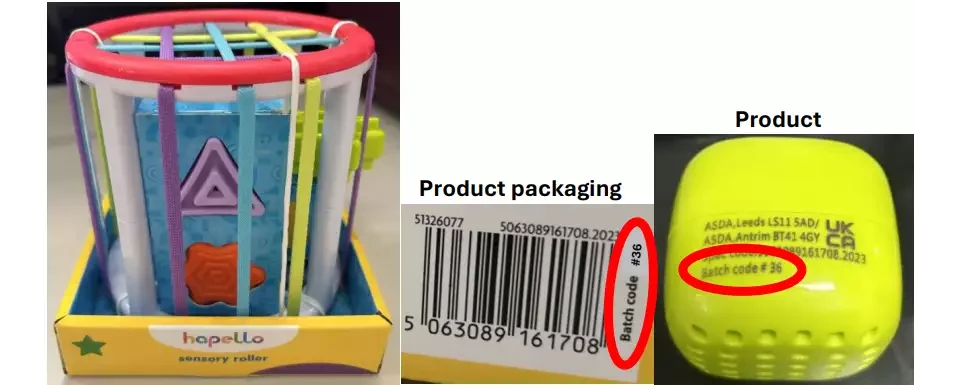
The sample photograph is especially easy to misread as the full scope. A visible #36 in the image demonstrates a location; it does not erase the other codes in the text. Read the picture and current list together. If you saved an earlier picture with one code circled, return to the updated list before deciding that a different listed code is outside the recall.
Where packaging is still available, keep it with the product comparison. A barcode identifies the named product, while the printed batch adds a production identifier. One does not automatically stand in for the other. If two toys were purchased together, inspect their own markings separately rather than assuming that the first readable toy represents both.
Treat an unreadable code as unresolved
If a mark is worn, missing or partly hidden, photograph what can be seen and ask Asda to clarify the item. Record uncertainty instead of guessing a character. Do not scratch away material, remove components or test the toy to try to establish a match. An adult can describe the product and show the available identifiers without creating another opportunity for a child to play with it.
A missing box or an unclear code should not be turned into an automatic clearance. Nor does it prove that every similar item belongs to the affected batches. Keep the item out of use while asking the retailer to resolve the specific identification question, using the notice reference and photographs of the toy you actually hold.
Why an intact-looking roller still needs action
The official hazard concerns a small piece of plastic that may have become lodged in the toy during manufacture and could be released. A young child could put that piece in their mouth and choke. This is different from a recall that asks owners to find an obvious crack or a visibly missing component before taking action.
A toy can therefore appear complete in a photograph without resolving the issue described in the notice. The fact that it was played with previously, or that an adult cannot see loose material from the outside, is not an exception stated in the recall. Use the product identifiers to decide whether the notice applies; do not substitute an informal home inspection for the official matching criteria.
The product description mentions removable shapes as part of the roller's design. That does not mean the notice identifies every intended removable shape as the manufacturing defect. Keep those descriptions separate so that a comparison does not turn into an unsupported claim about which visible component is responsible. There is no need to demonstrate the defect to a child or dismantle the roller to prove that the recall is relevant.
The published action is to stop use and return the product, rather than repair it at home, remove a suspected piece or continue playing under closer supervision. Avoid shaking, stressing or modifying a matching toy as an experiment. Keep it somewhere children cannot retrieve it while arranging the stated next step.
If a child is choking, seek immediate help and follow appropriate emergency guidance rather than continuing a recall search. The NHS guide to helping a choking child explains the age-dependent first-aid response. A product-return enquiry is not an emergency response service, and an online description cannot assess an individual child.
This guide does not add an injury count or estimate a particular child's likelihood of choking. Those figures are not supplied in the official notice. The absence of a stated count should not be treated as permission to disregard its stop-use instruction.
Return a matching roller using Asda's instructions
For the identified product and affected batches, Asda's instruction is to stop using the roller and bring it back to the nearest store for a full refund. The expanded retailer notice expressly says a receipt is not needed. Keep that product-specific instruction separate from ordinary returns policies or the terms of a different recall.
Before making the trip, keep the toy somewhere it cannot be put back into play and save the official notice on your phone or as a private printed reference. Have the product name, barcode and readable batch available. This is particularly helpful when another member of the household is arranging the return and did not make the original comparison.
The customer-care number supplied in both the regulator's record and Asda's notice is 0800 952 0101. Use it for unresolved identification or return questions. Describe the Hapello Sensory Roller recall specifically, rather than asking about all Asda toys, and retain any clarification relevant to your item.
If getting to a store is difficult, ask the retailer which arrangement is available in your circumstances. The published text does not establish a general postal-return service, collection promise, processing deadline or additional compensation. This guide cannot create one. Confirm the actual route before sending the toy somewhere or assuming a replacement will be provided instead of the stated refund.
If the receipt or original packaging is missing
A lost receipt should not be confused with an unreadable batch. Asda's notice resolves the first question by saying the receipt is unnecessary for the matching recalled product. The second question is about establishing which item you have. If the box has gone, use the product marking shown in the official photograph and ask Asda if the identification remains uncertain.
Do not reconstruct a missing label from an online resale listing or claim that a photograph of another toy is your purchase evidence. Tell the retailer which details are available and which are not. A gift recipient or second-hand owner can explain that history when asking how to proceed; the short notice does not set out a separate detailed procedure for every ownership route.
Use official contact information for the conversation. Product Recall Checker does not handle the return, approve payment or require account credentials. Keep private support correspondence and any financial information out of public comments, and do not follow an unexpected refund message merely because it uses the product's name.
Check toys kept outside the original purchaser's home
The person who bought the roller may no longer be the person who keeps it. Consider a toy left at a grandparent's home, passed to another caregiver, kept with travel supplies or put away for a younger child. The useful question is where the actual item is now, rather than who first saw the warning.
The government's advice on second-hand consumer products includes checking whether a product is subject to a recall. Ownership history and a product's outward condition do not replace that check. For this roller, a new owner should still compare the named item and its markings with the expanded official notice.
Send a caregiver the current official link with the full product name and a clear explanation that the code should be checked by an adult. A cropped picture of a colourful toy, without the barcode or the full batch list, can create either an unnecessary brand-wide warning or a missed match. Ask the current holder to confirm which item and marking they found.
A short household handoff can record:
- Where the toy is being kept while the check is unresolved.
- Which product marking was read and whether it was legible.
- Who is contacting Asda or arranging a return.
- Whether another household has a separate roller needing its own comparison.
These are practical coordination notes, not a claim that one comparison covers a whole collection. If a second toy has a different or unreadable mark, record that separately. An item should not be put back into a shared toy box merely because someone else is assumed to have dealt with it.
Do not pass a matching recalled roller on as a gift or let another household use it while a return is being arranged. Follow the stated recall action instead. If the item has already changed hands, tell its current holder enough to identify it without publishing anyone's address, receipt or private support correspondence.
For a broader review of other toys, the government's consumer product-safety guidance provides a starting point. Other products need their own notices and instructions; the Sensory Roller scope does not become a recall of an entire household's toy collection.
Keep the dates and UK sources straight
An accurate record prevents an old, narrow comparison from being reused as if nothing changed. Save the official reference 2503-0099, the product and markings you checked, the current source link, the date of your check and the action taken. If the code remains unreadable or the retailer is clarifying the item, record that as an open question rather than a completed clearance.
Original notice, expansion and reposts are different dates
The UK regulator's history separates the original publication from the later scope update. An older official page can also preserve earlier information for its own place and publication context. For example, the Government of Jersey entry dated March 24, 2025 identifies batch #36 only. That older description should not be used to remove four batches from the updated UK list.
| Date | What the cited record describes |
|---|---|
| March 24, 2025 | Original OPSS publication; the Jersey entry also records the initial notice. |
| November 17, 2025 | OPSS update broadening the recall scope. |
| November 20, 2025 | Darlington's later publication of the expanded information. |
The Darlington notice reproduces the five-code scope. Its later publication date is not evidence of another toy being manufactured that day or a third separate recall. When reading a shared warning, identify which date is being displayed before drawing a conclusion about a purchase.
Neither the original date nor the age of a search result establishes that a product action has finished. Recheck the current official wording for an actual change in scope or instructions. A small retailer news list, an old newspaper headline or the absence of a recent social post cannot independently close the case for a toy still held at home.
This site's US feed does not clear a UK toy
The OPSS recalls and alerts guide links to the UK register and explains its notice types. Use that register and Asda's notice for this UK check. Product Recall Checker's searchable feed uses U.S. agency data and is not a complete UK toy-recall register. No matching result here would therefore be an unsuitable reason to put the roller back into use.
Our About page explains the independent site's role. The baby-product recall guide provides broader help for U.S. searches, where those agencies are relevant. A different country or product requires its own source and identifier comparison; a familiar brand name does not remove that distinction.
Product Recall Checker is not Asda, Hapello or a government agency and does not approve refunds or individual product safety. Follow the current official notice and obtain retailer clarification when your particular item cannot be identified confidently. Keep the evidence and correspondence private while making the product's status clear to the adults responsible for it.
Comments
Comments are reviewed before publication. Do not post personal information, serial numbers, medical details, or emergency reports. For urgent safety concerns, use the official agency contact in the recall notice.
Sign in with Google to leave a comment
Loading comments...