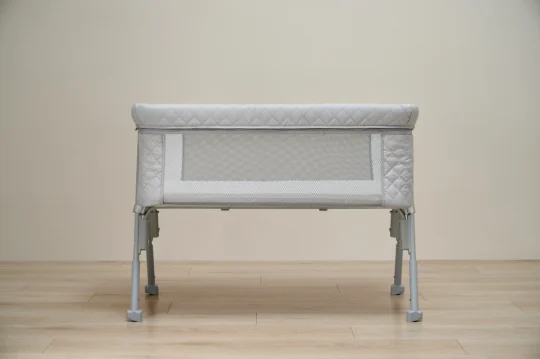
To check a baby product recall, first use the agency that regulates that type of product, then match the permanent label on the item against every identifier in the official notice. Use CPSC for cribs, strollers and most nursery gear; NHTSA for child car seats; and FDA for infant formula, baby food, medicines and regulated medical devices.
A brand-name search alone is not enough. Record the model or item number, serial number, manufacture date, lot or batch code, UPC, package size and use-by date that apply to the product. This guide was reviewed July 27, 2026. It explains the U.S. process but does not certify an individual product as safe.
Quick answer: use the agency that regulates the product
| Baby product | Primary U.S. recall source | Identifiers to collect |
|---|---|---|
| Cribs, bassinets, play yards, strollers, high chairs, swings, carriers, gates, toys and most durable nursery gear | CPSC Recalls and Product Safety Warnings | Brand or manufacturer, product name, model/item number, serial number, manufacture date and identifying features |
| Child car seats and booster seats | NHTSA Recalls | Manufacturer, model name and number, manufacture date, and campaign number if known |
| Infant formula, baby food, medicines and many feeding or monitoring products regulated as foods, drugs or devices | FDA Recalls, Market Withdrawals and Safety Alerts | Brand, exact product, package size, UPC, lot/batch code and use-by or expiration date |
| Baby foods containing meat, poultry or certain processed egg products | USDA FSIS Recalls and Public Health Alerts | Product name, package size, establishment number, lot/date fields and inspection mark |
Start by identifying what the product does. A stroller is generally a CPSC consumer product, while a child restraint used in a vehicle is handled through NHTSA. Formula belongs in the FDA food system. FoodSafety.gov also routes food searches to FDA or USDA and stresses that all identifying fields in a recall should match.
Collect the identifiers before you search
Take clear photos before typing anything into a search box. Photograph the whole product, its permanent label, packaging, warning labels and any receipt or online order record. Keep the original files so you can zoom in on small characters later.
For durable infant and toddler products, CPSC labeling rules call for identifying information such as the manufacturer, model name or number and manufacture date on the product. NHTSA child-restraint records similarly rely on the car seat's model number and date of manufacture. Formula notices commonly narrow a recall with a full lot code, package size and use-by date.
- Brand and legal manufacturer: the recall may be filed under an importer or supplier rather than the storefront brand.
- Exact product and variation: include size, stage, color or configuration when the notice uses it.
- Model, item or catalog number: copy hyphens, spaces and suffix letters.
- Serial number and manufacture date: these can limit a durable-product or car-seat campaign.
- UPC and lot/batch: record both for formula and packaged food; one is not a substitute for the other.
- Use-by or expiration date: treat it as a separate matching field, not part of the lot unless the notice says so.
Label locations vary by model. A crib label may be on a rail or headboard, a stroller label may be under the seat or on the frame, and a formula lot code may be on the can base or package seam. Use the official notice's product photos and description instead of assuming one location applies to every brand.
Check cribs, strollers and other baby gear with CPSC
CPSC recall notices cover consumer products such as cribs, bassinets, play yards, strollers, high chairs, baby carriers, gates and toys. A typical notice provides the recall date and number, affected product description, hazard, units, incidents, remedy, company contact and one or more identifying photos.
How to search a crib or stroller
- Open the CPSC recall database.
- Search the brand, then the manufacturer or importer printed on the label.
- Try the model number by itself and with the product type, such as "crib," "stroller" or "bassinet."
- Open a possible notice and compare the complete model range, manufacture dates, colors, features and label photos.
- Read the remedy and consumer-action section all the way through before altering, returning or discarding the product.
A current example shows why the label matters. In a March 26, 2026 AirClub convertible bassinet recall, CPSC identifies model QX-831 on a label beneath the mattress pad. That location is specific to this product; another bassinet or crib can place its label elsewhere.
What to do when a CPSC notice matches
Follow the exact notice. CPSC remedies can include a repair, refund, replacement, return or documented disposal. Some safety warnings tell consumers to stop use and destroy the product because no cooperative recall remedy is available. Do not promise yourself a refund based on a different recall.
If the notice asks for a photo of a label or destroyed item, save readable photos and proof of purchase before completing that step. Do not improvise a repair, remove a required part or discard the evidence until you understand the firm's process. Federal law prohibits selling a consumer product that is subject to a CPSC recall.
Check car-seat recalls with NHTSA
A vehicle VIN lookup does not replace a check of the child restraint itself. The car seat or booster has its own manufacturer, model number and manufacture date. A NHTSA campaign may affect selected seats or date ranges without recalling the vehicle in which the seat is installed.
- Find the permanent model/date label on the shell, base or underside specified by the manufacturer.
- Copy the complete model number and manufacture date.
- Search NHTSA recalls and the manufacturer's recall page.
- Open the official campaign record and owner-notification documents.
- Match the listed models and date range, then follow the interim and remedy instructions.
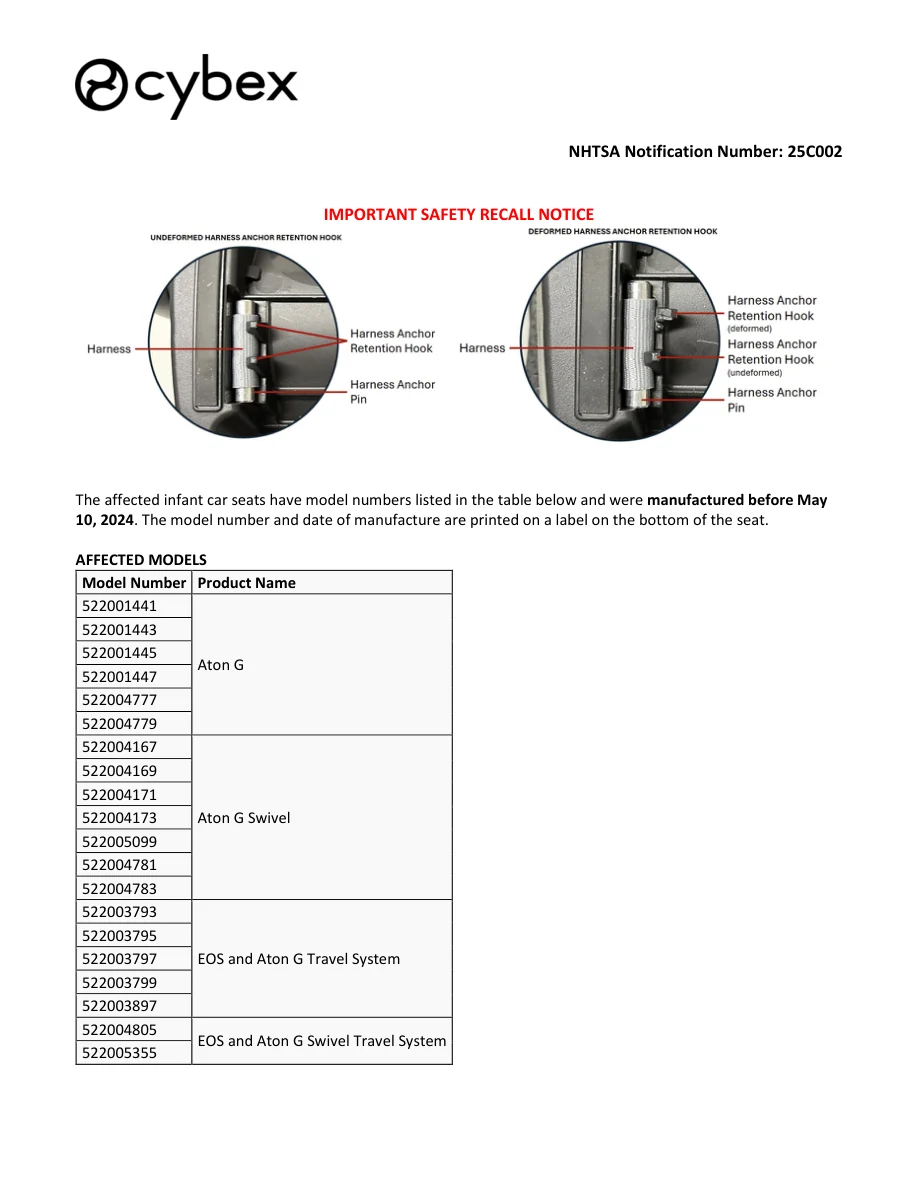
The image comes from NHTSA campaign 25C002 and is an example, not a universal car-seat list. Its retailer notice says the affected Cybex models and manufacture date are printed on a label on the bottom of the seat. Another campaign can use different labels, dates and instructions.
Register the car seat for direct notice
Register a new child restraint with the manufacturer using the included card or its online form. Registration links your contact information to the model and manufacture date so the manufacturer can send a recall notice. NHTSA recommends registering safety equipment and checking for recalls periodically, including for used products.
Registration helps with recall outreach; it does not prove that a secondhand seat has never been in a crash, has all required parts, is within its manufacturer-defined service life or has been stored correctly. Those questions require the manufacturer's instructions and, when appropriate, help from a certified child passenger safety technician.
Check infant formula and baby-food recalls with FDA
For formula and most baby food, search the FDA recall and safety-alert index. FDA notes that its public press-release list does not contain every recall, so also check the agency's product-specific pages and enforcement information when a package or supplier raises concern.
Do not compare only the front label or an online listing. Put the physical can, bottle, pouch or box in front of you and match:
- brand and exact product name;
- formula stage, preparation type or variety;
- package size and UPC;
- complete lot or batch code, including suffixes;
- use-by or expiration date; and
- distribution area, if the notice limits where the product was sold.
If every stated field matches, do not open or feed the product. Follow the notice's return, refund, disposal and medical instructions. Do not treat a safety alert, outbreak investigation or market withdrawal as interchangeable with a recall; the linked agency page explains the action and scope.
For a real example of country- and batch-specific matching, see our Nestle baby formula recall guide. Its overseas batch tables should not be used to judge a U.S. package from a different market.
Specialty formula and substitutions need professional guidance
If a recalled product is prescribed, hypoallergenic, elemental, metabolic or otherwise medically necessary, contact the baby's pediatrician or healthcare team promptly for a suitable alternative. FDA's information for parents and caregivers identifies healthcare providers as the best resource for formula selection.
Do not dilute formula, stretch feeds or use a homemade recipe. FDA warns that homemade formula may have inadequate nutrients and may be contaminated. A replacement that seems similar on a store shelf may not be appropriate for a baby with allergies, prematurity, metabolic needs or feeding intolerance.
How to check secondhand baby products
A used crib, stroller, high chair or car seat needs an identifier-based check before use. A visual resemblance to a recall photo is not enough, and a missing label is not evidence that the item falls outside the recall.
- Ask the seller or giver for the original model, serial and manufacture labels before accepting the item.
- Check the brand, legal manufacturer/importer, model and product type in CPSC or NHTSA records.
- Compare the official notice's label photos and complete date/model range.
- Verify that required hardware, restraints, instructions and recall-repair parts are present.
- If essential identifiers are missing, altered or unreadable, contact the manufacturer; do not guess from color or shape.
CPSC's reseller guidance explains that recalled consumer products cannot legally be sold. Do not buy, sell, donate or give away an item that matches a recall unless the official remedy has been completed and the notice permits continued ownership or transfer.
For a used car seat, recall status is only one part of the decision. Unknown crash history, missing parts, expiration or damage may make the seat unsuitable even when no open recall appears.
Register products and subscribe to alerts
Registration and alerts reduce the chance that a recall depends on seeing a news story. Register durable infant products and car seats with the manufacturer as soon as possible. Keep the confirmation, model number and manufacture date with your household records.
- Use CPSC's recall page to choose email notifications.
- Register child restraints with the manufacturer using the model/date label.
- Use FDA's email update subscriptions for food and safety information.
- Review our latest recall records as a discovery aid, then open the linked government or manufacturer notice.
Alerts supplement a current lookup; they do not replace one for a used, imported or previously unregistered product.
What a no-result search does and does not mean
No search result is not a safety certificate. It means the terms used did not produce a matching record in that database at that time. A recall may use the manufacturer's legal name, importer, former model name or a different product description. An independent index may also update on a different schedule than the issuing agency.
If the first search finds nothing:
- search the brand, manufacturer and importer separately;
- try the model number with and without punctuation;
- search the product type plus a distinctive model or item number;
- confirm that you used CPSC, NHTSA, FDA or USDA for the correct product category;
- check current safety warnings as well as formal recall pages; and
- contact the agency or manufacturer when the label cannot be reconciled.
Stop using a product and seek authoritative guidance if it is broken, missing a safety label, involved in an incident or appears to present an immediate hazard, even when a recall search is empty. A recall database is not a physical inspection.
Baby product recall FAQ
Can I keep using a recalled product until the repair arrives?
Use only the interim instructions in the exact official notice. Many baby-product recalls require immediate stop-use; others provide a specific temporary action. Do not invent a workaround or assume advice from another model applies.
Can I sell or donate a recalled baby product?
Not while it is subject to a CPSC recall. Federal law prohibits selling recalled consumer products, and notices may also say not to give the item away. Follow the stated repair, return or disposal process.
Is a UPC enough to identify every recall?
No. A UPC often identifies a product line, while the recall can be limited by lot, batch, manufacture date, model, size or expiration. Match every field listed in the notice.
Should I check a car seat with the vehicle VIN?
Check both when relevant. A VIN search covers the vehicle, while the child restraint has its own model and manufacture-date label and may be part of a separate NHTSA equipment campaign.
Is Product Recall Checker a government service?
No. Product Recall Checker is an independent discovery tool, not CPSC, NHTSA, FDA, USDA or a manufacturer. The official notice controls the affected scope, safety action and remedy.
Comments
Comments are reviewed before publication. Do not post personal information, serial numbers, medical details, or emergency reports. For urgent safety concerns, use the official agency contact in the recall notice.
Sign in with Google to leave a comment
Loading comments...