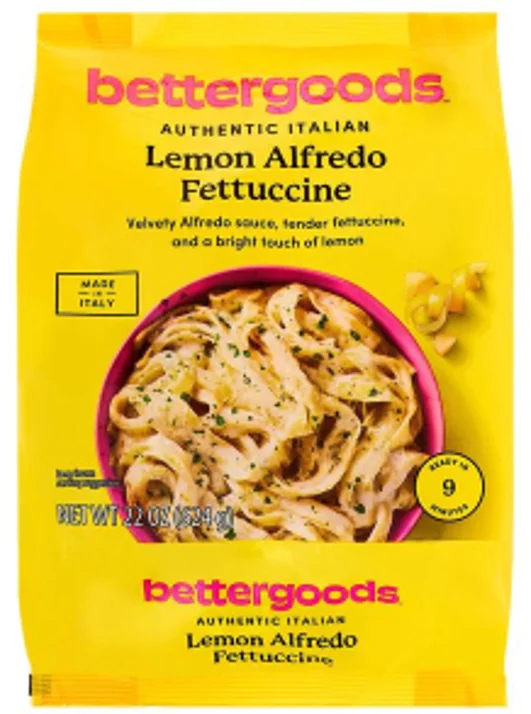
A Walmart Listeria recall applies to the products and identifiers in a specific official notice. As checked October 9, 2026, a recent example is bettergoods Authentic Italian Lemon Alfredo Fettuccine: the October 1 expansion covers all lots of the specified 22-ounce frozen product, not just the two lots in the original September notice. Check the exact name, package size, UPC, notice version and any other affected codes before deciding whether your food matches. Older BrucePac and prepared-pasta stories concern different events. This guide explains those distinctions and the next steps; it is not a complete inventory of every recalled item sold by Walmart.
The 2026 bettergoods pasta recall expanded to all lots
The October 1, 2026 Gias Foods announcement identifies frozen bettergoods Authentic Italian Lemon Alfredo Fettuccine, a yellow 22-ounce bag with UPC 194346442706. It covers all lot codes of that product and reports nationwide distribution at Walmart stores. The stated concern is potential Listeria monocytogenes contamination. These identifiers define the scope: the announcement does not recall every bettergoods product or every frozen pasta sold by the retailer.
The notice attributes the finding to routine sampling by Washington State and Florida agriculture agencies. It reported no illnesses at the time of the announcement. That statement is dated to the notice; it should not be turned into a later independently verified illness count. The announcement directs purchasers to return the affected product to the place of purchase for a full refund and gives [email protected] for questions.
To check a freezer item, start with its front label, then turn the sealed package to its barcode. A familiar yellow bag is a useful visual lead, but color alone cannot confirm the match. Read the complete product description and weight instead of assuming two neighboring bags contain the same recipe. Save the expansion link with your purchase information so a household member does not accidentally use an earlier search result.
Why the September lot list is no longer sufficient
The September 15 initial announcement listed L6079C and L6080C, with expiration dates September 19 and September 20, 2027. Those two codes remain useful for understanding the original announcement. They are no longer an adequate exclusion test after the all-lot expansion for the same specified product.
For example, finding a different lot on a matching 22-ounce Lemon Alfredo bag does not place it outside the October scope. Conversely, finding the same retailer or brand on a different product does not place that item inside this recall. Read “all lots” together with the product description; the phrase changes the lot boundary, not the brand boundary.
This distinction also helps when an old screenshot circulates without its update link. Reopen the official page and follow the link between the initial and expanded announcements. Keep the package expiration date separate from the announcement date. One describes the manufacturer's date on the food; the other identifies the recall version. A long printed expiration date does not cancel the recall or make a matching frozen bag suitable to eat.
Separate older Walmart Listeria events
The retailer's name can connect search results about events separated by years. Before using a product list, identify its company and announcement date. The BrucePac meat and poultry recall in 2024, the prepared-pasta investigation in 2025 and the Gias bettergoods announcement in 2026 are distinct records. This guide has not verified a connection between the Gias event and the earlier investigations. Similar meal names and the same bacterium do not establish such a connection.
BrucePac meat and poultry in 2024
The FSIS October 15, 2024 update expanded an October 9 BrucePac recall and directed readers to its product and label information. The official New York State Education Department repost gives production dates May 31 through October 8, 2024 and establishment numbers 51205 or P-51205. It explains that other establishments could have used affected meat or poultry in ready-to-eat foods.
That supplier history is a reason to check the final packaged meal against the official label list. Searching only for “BrucePac” on the front of a retail meal may miss the relevant connection. However, a chicken ingredient or a purchase at Walmart is not enough to conclude that a particular meal was affected. Use the label details attached to the event, rather than treating a social-media brand list as the complete scope.
This is a historical 2024 example, not an announcement of a new 2026 BrucePac recall. The sources checked here do not establish its present administrative termination status. If you are investigating a retained frozen item from that period, use the original event's product information and company contact instead of transferring the current bettergoods identifiers to it.
Prepared pasta meals in 2025
The FDA 2025 prepared-pasta overview lists Marketside Grilled Chicken Alfredo with Fettuccine in 12.3-ounce packages with best-by dates June 26, 2025 or earlier, and 32.8-ounce packages dated June 27, 2025 or earlier. Its separate Marketside Linguine with Beef Meatballs & Marinara Sauce entry is a 12-ounce product covered by an FSIS public health alert, with specified September and October 2025 dates.
Those products are not interchangeable with the 22-ounce bettergoods frozen Lemon Alfredo bag. The FDA outbreak page reports that the outbreak and investigation ended in its February 12, 2026 update. It still advises checking refrigerators and freezers for affected meals and not eating them. An ended outbreak does not turn an old matching package into an acceptable meal; it also should not be described as a newly announced outbreak today.
Match a Walmart purchase to the official product list
Use Walmart's Product Recalls page to locate the linked manufacturer or agency announcement. The retailer explains that the links concern products sold through its stores and websites, including Sam's Club channels. Read the actual notice rather than stopping at the index title. A date and retailer name can locate an event, but they usually cannot identify the lot in your kitchen.
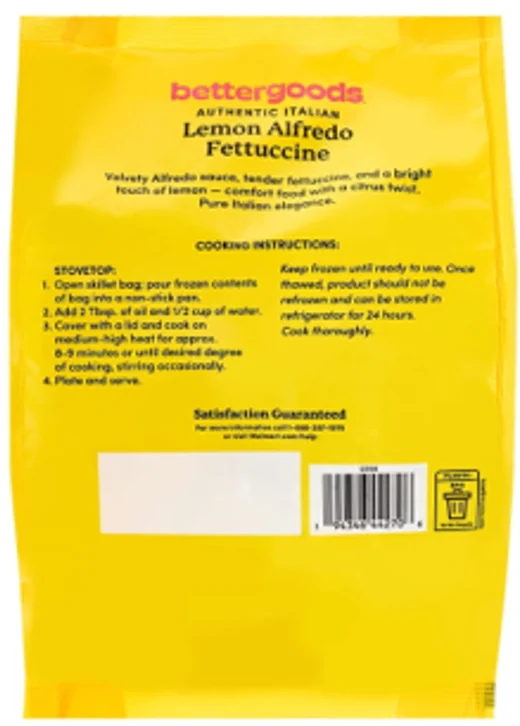
The FDA consumer recall guide describes useful fields including product name, size, packaging, UPC, product codes, printed dates and distribution. Compare each applicable field side by side. Copy letters and digits exactly, including leading zeros. For a multi-product attachment, inspect the entire matching row: a UPC in one row and a date in another are not a valid combined match.
| Question | Evidence to compare |
|---|---|
| Is this the same food? | Complete recipe name, brand and package weight. |
| Is this the same recalled range? | UPC, lot, printed date and any establishment number required by the notice. |
| Was this purchased through an affected channel? | Receipt, order details and published distribution information. |
| Am I using the correct version? | Original announcement plus any linked expansion or correction. |
Walmart's purchase-history instructions explain that qualifying store purchases made with a saved payment card can appear in an online account. They also explain how to scan a receipt and locate order receipts. This can recover the product and purchase date when a paper receipt is missing. It does not necessarily recover the physical package's production lot, so compare the actual label whenever you still have it.
If a bag was discarded or a meal moved into another container, write down the missing identifier. A receipt showing a related product can support a question to the company; it cannot justify inventing the lot. If your account does not show a purchase, consider whether it was bought with another payment method or by another household member. An absent account entry does not resolve the recall match. Keep the food out of use while you clarify a plausible match, and ask the official contact which additional information can settle the uncertainty.
Check Listeria notices beyond a retailer headline
A Listeria search also needs the manufacturer name and exact recipe. A separate 2026 example is Kettle Cuisine's Marketside Tomato Bisque Soup Kit notice. The company announced it August 12, and FDA published it August 13. It specifies 14 ounces (397 grams), UPC 194346474004 and use-by August 22, 2026. The notice identifies distribution to select Walmart stores in listed states, rather than every store or every Marketside soup.
The soup's printed date had passed by this guide's October 9 check. Treat the notice as a dated product-specific event, not proof the food remains available on shelves. A package retained from that range still needs its own notice's instructions: the company says not to eat it and to dispose of it or return it for a refund. This scope is different from Gias's all-lot Lemon Alfredo expansion. Using the pasta rule to evaluate the soup would erase the very identifiers that make the soup notice useful.
When a retailer index supplies a short title, open its linked agency page and read the reason. A withdrawal for an unrelated problem, a recall for another organism and an outbreak investigation are not automatically Listeria recall entries. Record the issuing agency and notice type alongside the hazard. For meat or poultry meals, include the FSIS announcement or alert when the federal overview links it, rather than insisting every food event must appear as an FDA company announcement.
Supplier recalls and finished meals are different records
The FDA 2025 pasta overview explains that Nate's Fine Foods did not sell the affected ingredient directly at retail. Its table connects notices for companies that used or repackaged the pasta. The ingredient name therefore helps trace the event, while the finished-product notice helps a shopper identify the package.
Work through that connection in order: supplier, finished-food company, retail brand, then package identifiers. Do not add a meal to the affected list solely because it contains pasta or chicken. If the overview names a downstream product, follow its link for the actual size and dates. If you cannot find that product in an official linked notice, ask the company rather than filling the gap with an assumed supplier relationship.
Page timestamps also matter. The 2025 major-event overview retains an earlier investigation update, while its linked outbreak page later reports the investigation ended. Use the outbreak page for that investigation's latest reported status and the product announcement for package scope. Two differently updated pages can serve different purposes. Neither a later status update nor an older product table should be silently substituted for the other.
What to do with matching food and an unresolved exposure
Stop serving a matching product and follow its notice. Do not use its smell, appearance or a taste test to decide whether it is suitable to eat. Set the package aside from food that someone might prepare while you read the disposal or return directions. If you shared the affected item, send the official product notice to the recipient with the relevant package details, rather than a broad message implying that all food from the retailer was recalled.
Clean areas that contacted potentially contaminated food. The CDC refrigerator guide explains removing food, washing removable parts, cleaning interior surfaces and washing hands. Follow the product notice's handling precautions too. A refund inquiry should not delay keeping the food out of use or cleaning a spill. Photographs and order details can preserve information without keeping suspect food indefinitely.
Refund instructions and useful documentation
Use the remedy for the event you actually matched. Gias's expansion directs a return to the place of purchase for a full refund. The Kettle Cuisine soup notice allows disposal or return for a refund. Walmart's food recall help says not to consume recalled food, to discard it and visit a store for a full refund in accordance with its refund policy. Its general return guidance also refers to items actively under recall.
Because those instructions have different contexts, contact the store or company before transporting suspect food if the required handling is unclear. Give the exact product, notice link and purchase details. Ask how to document the affected package and follow the applicable instructions. This guide does not establish whether a historical event remains eligible under the retailer's current policy or promise a refund for an unverified match.
A useful inquiry states what is known and what is missing: “I bought this product on this date; the UPC matches; I cannot read the lot.” Attach a clear label photograph if requested through an official channel. Keep any confirmation and the name of the notice used. That makes a follow-up more useful than repeatedly sending a headline that lacks the package information.
When to contact a healthcare professional
The CDC advises contacting a healthcare provider if you ate recalled or outbreak-linked food and have a fever with other listeriosis symptoms, such as fatigue or muscle aches. Tell the provider about the possible exposure. CDC emphasizes this information especially for pregnant people, adults 65 or older and people with weakened immune systems. For questions after an exposure without symptoms, ask a healthcare professional about your circumstances rather than starting treatment yourself.
Record what was eaten, when, and the product identifiers, but do not diagnose illness from a recall match. Product Recall Checker is independent and does not replace agency notices or medical care. Its Walmart recall lookup guide and latest listings can help locate records; the official company and agency documents supply the affected scope and actions.
Comments
Comments are reviewed before publication. Do not post personal information, serial numbers, medical details, or emergency reports. For urgent safety concerns, use the official agency contact in the recall notice.
Sign in with Google to leave a comment
Loading comments...