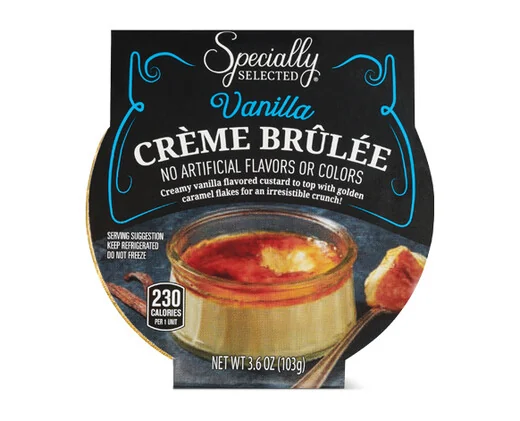
The ALDI dessert glass recall involved Specially Selected Vanilla Crème Brûlée, 3.6 ounces/103 grams, with a May 9, 2026 best-before/use-by date and barcode 4099100342826. It is a historical April 2026 recall. The FDA data checked October 17 lists it as terminated on July 9, 2026. That status does not make an old matching dessert suitable to eat.
This guide explains the exact package check, the dates in the record and what information to bring to ALDI. Product Recall Checker is independent and does not replace FDA records, retailer instructions or professional medical advice.
What happened to ALDI’s vanilla crème brûlée?
FDA recall H-0680-2026, event 98771, identifies Lactalis Canada as the recalling firm and describes possible glass foreign objects in the dessert. The recorded quantity is 2,869 cases. Cases are not individual jars: the record does not provide a reliable conversion into a total number of desserts, so avoid treating those units as interchangeable.
| Record field | Date in 2026 | What it describes |
|---|---|---|
| Recall initiation | April 14 | The company began the recall action |
| Center classification | April 28 | FDA assigned Class II |
| Report date | May 6 | The enforcement-report entry |
| Termination | July 9 | The recorded end of the regulatory recall process |
The FDA enforcement event and its machine-readable product record allow you to look up the same event. A news story published after initiation does not establish another new recall. Similarly, classification is a risk assessment milestone, not proof that a company expanded the product boundaries that day.
FDA’s status definitions explain termination in terms of reasonable removal or correction efforts and appropriate disposition. This is different from a statement about every jar ever sold. If you discover an affected package in storage, continue to treat the package according to the recall rather than interpreting a closed regulatory process as a food-safety clearance.
The record does not supply an injury total, a fragment-size distribution or a detailed manufacturing explanation. Those missing fields should remain unknown. The actionable facts are the named dessert, its identifiers, the potential glass hazard and the historical status—not an invented account of how the glass entered it.
Match the dessert using all three identifier groups
Use the complete label check below rather than a single clue such as a black wrapper, a glass cup or a familiar brand. FDA’s food-recall guidance explains why notices contain several identifying fields. The fields work together: the product description identifies what was sold, the barcode identifies the retail item, and the date narrows the affected stock.
Product name, portion size and glass packaging
The record names Specially Selected Vanilla Crème Brûlée, with a net weight of 3.6 ounces, or 103 grams, packaged in glass jars. Read the actual net weight on your label. A product page, old review or delivery-app listing may describe a different presentation, round a weight or reuse a photograph. None should override the FDA description when checking this event.
Keep individual-portion information separate from any outer carton. A photograph of several desserts does not establish how many were in each recalled case. Likewise, the word “glass” describes both the reported foreign-object hazard and the product’s container material; it does not mean every ALDI dessert sold in glass is affected.
Barcode and product number
The official code information lists barcode 4099100342826 and product number 710298-4099100342826. Copy the full sequence, including the product-number prefix. These are identifiers for this record, not instructions for decoding a manufacturing date. FDA does not supply another batch number in that code field, so there is no additional lot code to invent or infer from a receipt.
Photograph the barcode, product number and nearby text together if possible. If an outer sleeve was removed, look through retained packaging or an earlier photograph before asking the store for help. A shopping-history entry can confirm that you purchased crème brûlée, but usually cannot establish the printed date of the particular jar you took home.
The May 9, 2026 date restriction
The listed best-before/use-by date is May 9, 2026. The record does not describe every date or a continuous date range. A barcode match without this date check leaves the historical comparison incomplete. If the date is illegible or missing, explain that uncertainty to ALDI rather than marking it as an unaffected package.
FDA’s date-label explanation also distinguishes ordinary quality dating from food-safety questions. A date printed on food does not cancel a recall, and a recall is not a general statement about how long every dessert remains suitable to eat. Here the date is an identification condition in a specific glass-contamination record.
Where the recalled dessert was distributed
The FDA record names seven states: New York, Indiana, Florida, Illinois, Virginia, Maryland and Michigan. It describes the product as sold exclusively by ALDI. It does not provide a store-by-store receiving list, a purchase-date interval or a statement that every ALDI location in those states received affected desserts.
FDA defines a distribution pattern as a general area of initial distribution and notes that later distribution may not be included. Treat this information as a tracing aid. Your current home address is not a substitute for the purchase location, especially if you bought the food while traveling or received it from someone else.
To ask a store about a historical purchase, provide the store location, approximate purchase date, product name, barcode and any retained date photograph. Separate what the store can verify from what remains unknown. A receipt showing the product is useful, but it does not by itself prove that the package carried May 9, 2026. An affected date photograph can be stronger package evidence even when the receipt has been discarded.
The reverse distinction matters too. Living in a named state does not mean every crème brûlée in your refrigerator belongs to this recall. Matching the full product and date avoids broadening a specific event to all desserts sold in that area. If the food was shared, trace the actual purchase and package rather than warning recipients that all ALDI food is affected.
Our ALDI recall guide provides a broader starting point for different products. Use a separate official notice for each one. An ALDI cheese, vegetable or appliance action has its own identifiers and cannot supply missing fields for this dessert.
What the glass hazard and Class II classification mean
This record concerns a physical foreign object, specifically glass. It is not a Listeria, Salmonella or undeclared-allergen recall. Although the product description also contains ingredient and allergen information, those label details do not change the stated recall reason. Use a different official notice for a different hazard, even when the retailer or ingredient is similar.
FDA’s hard-or-sharp-object guidance explains that such objects can injure the mouth, throat or digestive tract and damage teeth or gums. The dessert record does not identify fragment measurements. Do not import a measurement from a general enforcement policy and use it as a home test that clears a recalled dessert to eat.
Class II is FDA’s assessment of relative health risk. It does not mean harmless, and it does not predict what will happen to a particular person. Our FDA recall-class guide explains the categories. For a consumer deciding what to do with a matching jar, the useful action is to stop serving it and obtain the retailer’s handling instructions, rather than debating whether the category sounds sufficiently serious.
A suspected swallowed fragment needs professional advice
If you suspect someone swallowed glass, contact a healthcare professional promptly. Do not wait for an online recall lookup to diagnose the problem or for a store to approve a refund. MedlinePlus’s swallowed-foreign-object guidance explains why sharp objects can require medical assessment. Trouble breathing or choking needs emergency help; in the United States, call 911.
Tell the clinician the food involved, when it was eaten, any symptoms and whether a fragment was actually observed. Distinguish “ate a recalled dessert” from “saw and swallowed a fragment”; they are different pieces of information. Keep a label photograph available without delaying care. Do not induce vomiting or use a home remedy to try to move an object through the body.
A record with no published injury count cannot tell you that no one was injured. Equally, the existence of a recall does not prove that every jar contained glass or that a particular symptom came from it. Medical professionals assess the person; the official record identifies the product boundaries.
What to do with stored desserts and retained jars
If a stored dessert matches the recall, do not eat it or offer it to someone else. FDA’s consumer instructions say to follow the specific recall directions and not give recalled food to a food bank or a pet. A potential physical contaminant is not a problem to solve by removing the topping, straining the custard or heating the remaining dessert.
Keep the product separate while arranging its handling. If you can safely photograph the intact package, capture the information before any disposal or return. Do not open a sealed jar to search for a fragment, and do not put fingers into food or loose broken glass to obtain evidence. Ask the store what it needs and how it wants a damaged package handled.
Unopened desserts and missing outer packaging
An intact seal does not change the product identifiers in the recall. Check unopened packages as carefully as opened ones. If a wrapper or sleeve has been discarded, look for retained photographs and purchase records, and tell ALDI which fields you can and cannot verify. Do not borrow the date from a different jar simply because the two were purchased together.
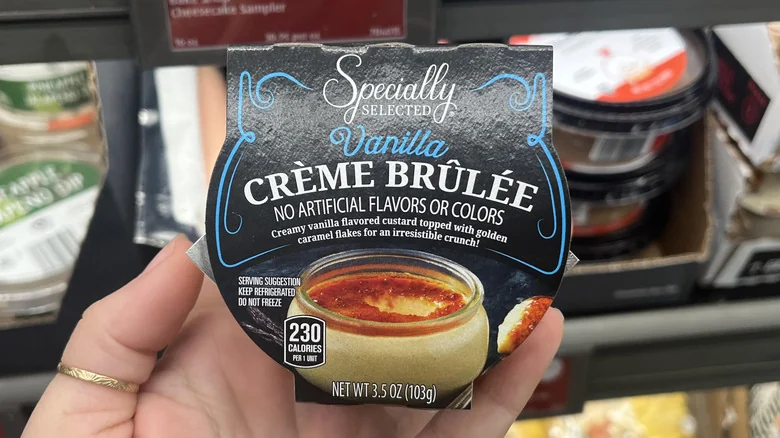
Older photographs are useful for recognizing the product family, but the exact printed fields still control the comparison. If important information is missing, ask for clarification; do not turn an incomplete search into a definite statement that the dessert is unaffected.
An empty dessert jar is a different question
A retained empty jar raises a packaging-use question rather than a decision about eating the recalled custard. FDA’s record is a food recall for possible glass foreign objects. It does not establish that every jar has a structural defect, identify a manufacturing cause, or certify the container for future oven, broiler, microwave or food-storage use.
Do not use a reuse tip from a product review as an answer to an unresolved safety question. Ask ALDI about the particular container and any applicable manufacturer instructions. If the jar is damaged or came from a package under investigation, describe that clearly. An old dessert recall alone cannot supply either a blanket housewares recall or a blanket assurance that every saved jar is suitable for a new purpose.
Prepare a clear return or customer-service request
For this historical event, begin with ALDI’s official product-feedback form or ask the store where you purchased the dessert. The FDA data identifies the event but does not provide a dedicated consumer claim form, a recall-specific telephone number or detailed return requirements. Ask for the current instructions rather than using a phone number copied from an unrelated ALDI recall.
A concise request can say: “I am checking Specially Selected Vanilla Crème Brûlée against FDA recall H-0680-2026, event 98771. My package shows [barcode], [product number] and [printed date]. It was purchased at [store] around [date]. Please confirm whether it matches and what you need for a return.” Attach readable photographs where available and state which information is missing.
Before transporting a jar, ask whether the store wants the physical product, packaging photographs or proof of purchase, and how to handle any suspected broken glass. Do not assume that an ordinary satisfaction guarantee establishes the remedy for every safety recall. FDA’s general guidance says recalled food can often be returned for a refund, but the specific company process still needs to be confirmed. This guide does not promise a replacement, doubled benefit or payment of medical expenses.
If the dessert has already been discarded, say so. Retained photos, order history and a receipt can support an inquiry without pretending that you still possess the food. Save the response and reference number. A submitted message is not the same as an approved claim, and an approval is not the same as a completed refund.
A suspected injury or foreign-object finding can also be reported through FDA’s Safety Reporting Portal. Describe the observation, product codes, purchase details and relevant medical assessment accurately. Keep the report separate from a customer-service request: one supplies safety information to a regulator, while the other asks the retailer to resolve your purchase.
Check the current record before sharing an old headline
A headline saying “ALDI dessert recalled” may remain searchable long after the original announcement. Before forwarding it, check three separate dates: when the recall began, when the source published its story and when you last verified the official status. For this event, an April or May article describing an ongoing recall predates the July 9 termination recorded in the FDA data checked for this guide.
Use the recall number to find the same event rather than searching only the retailer’s name. FDA’s enforcement-report explanation notes that not every recall appears as a public warning. A product’s absence from a short media list or the currently retrieved ALDI recall index does not erase an existing FDA record. Conversely, a broad retailer list does not establish that a new glass issue has occurred with this dessert today.
Keep a compact record of your own check: official event link, date checked, product name, package codes, printed date and any reply from ALDI. Mark fields as confirmed or unknown. This is more useful than saving a screenshot that contains a product photograph but omits the date restriction. If someone else shared the food or bought it for you, give them those exact identifying details.
Separate the conclusion you can support from the one you cannot. You can establish that a particular labeled dessert matches the historical record. You cannot establish the condition of every jar from the brand name, infer a root cause absent from the record or certify a reused container from an old recall article.
For a different current ALDI notice, start a new product check through our latest recall listings and follow its official source. Retain the historical dessert record for its specific purpose: identifying the affected crème brûlée and understanding the recorded action without presenting it as a newly announced recall.
Comments
Comments are reviewed before publication. Do not post personal information, serial numbers, medical details, or emergency reports. For urgent safety concerns, use the official agency contact in the recall notice.
Sign in with Google to leave a comment
Loading comments...