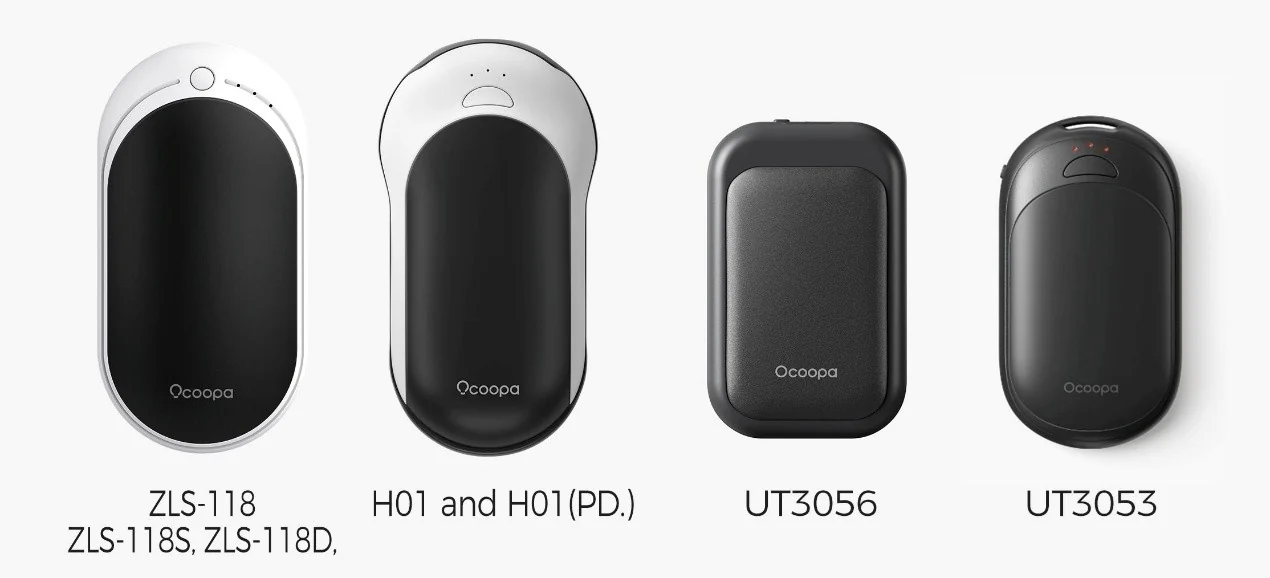
The OCOOPA hand warmer recall offers a full refund for affected products, but submitting a form, receiving a confirmation and receiving money are separate steps. First check the model number and three-digit batch number on the underside. Stop using an affected warmer immediately, apply through OCOOPA's official recall page and keep your claim records if payment has not arrived.
This guide reflects official information checked on October 27, 2026. The recall itself was announced on July 30, 2026. It is an existing recall with ongoing claim questions, rather than a newly announced October recall. Product Recall Checker is an independent website; the agency notice and OCOOPA's current instructions remain the controlling sources for your product.
Check whether your hand warmer is in the recall
The CPSC notice, recall number 26-659, concerns approximately 1.5 million rechargeable hand warmers. Their lithium-ion batteries can overheat and ignite. The recall identifies seven models, so the OCOOPA name on its own is not a complete match.
Gather the product itself, any packaging you retained and the purchase record before starting the form. These items answer different questions: the product label identifies the warmer, while an order record helps explain where and when it was purchased. A familiar color, an old shopping photograph or a marketplace listing can help you search your records, but none should replace the actual identifier when it is available.
Match the model and photograph the underside
| Field | What to check |
|---|---|
| Affected models | UT3053, UT3056, ZLS-118, ZLS-118S, ZLS-118D, H01 and H01(PD) |
| Identifier location | Model and three-digit batch number on the underside |
| Product appearance | OCOOPA-branded rechargeable warmers sold in pairs that join magnetically |
| Reported sales period | September 2018 through May 2026 |
Photograph each unit you intend to include, rather than assuming both halves have identical printing. Keep a wider photograph that shows the product and a close photograph in which the label can be read. The batch code is supporting information for the claim; do not substitute it for the model number or invent a batch eligibility range from another person's successful application.
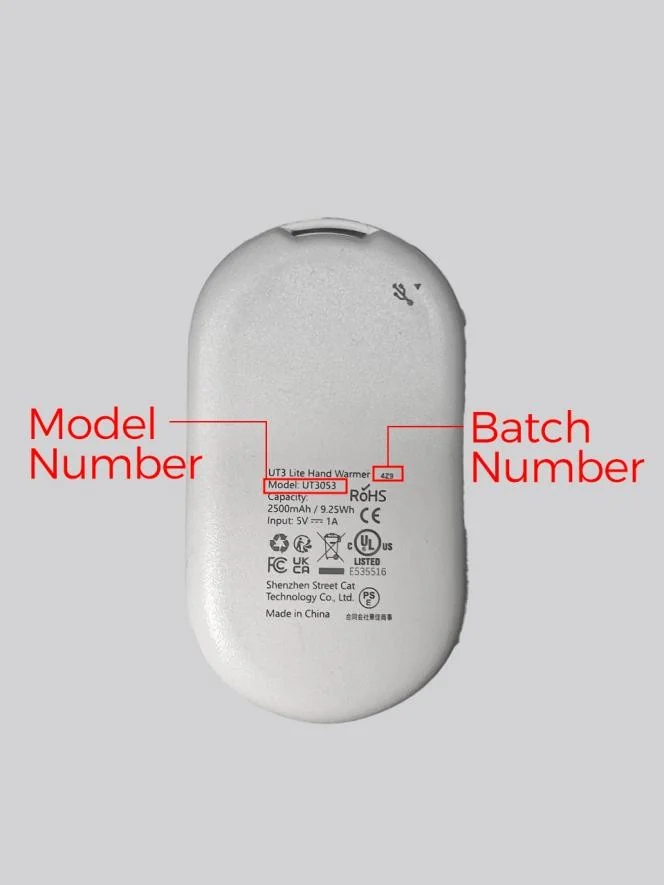
What to do when the printing is unreadable
If the label has worn away, do not guess digits to make a form accept the entry. OCOOPA's current recall FAQ directs owners who cannot find a model number, or cannot tell whether their product is included, to [email protected]. Explain exactly what is missing and attach whatever clear product and packaging photographs you have.
For example, an order record might show a marketing name while the underside uses a technical model code. Send both pieces of information and ask the company to resolve the identification question. An uncertain match is a reason to seek clarification before continuing use or claiming a particular remedy; it is not evidence that every product sold under a similar name belongs to this recall.
Submit a claim that can be reviewed
Begin at OCOOPA's official recall page and follow its claim button. This keeps the product identification, current instructions and submission route together. A general returns page may describe normal shopping returns or warranty coverage; use the dedicated recall process when requesting this recall remedy.
Before pressing submit, check that the email address is one you can access and that the uploaded pictures actually display. Keep a copy of the information you send. If the form fails, a screenshot of the error and a short explanation are more useful to support staff than repeatedly sending an identical submission without knowing whether the earlier one arrived.
Prepare the product photos and purchase details
OCOOPA's official request guide asks for contact and purchase information along with product photographs. Its preparation list includes the purchase platform, purchase date and order information if available. The picture requirements include the product, its model label and the product marked RECALLED. CPSC specifies permanent marker and evidence showing the model and three-digit batch number.
Position that marking so it does not cover the information needed to identify the unit. Check the photograph at full size before uploading: a clear overall view can become unreadable if a phone focuses on the background. Keep the original image as well as the uploaded copy. You do not need to open the shell or damage the battery to demonstrate a label or the requested marking.
If you cannot find an order number, explain that to the recall team rather than supplying a number from a different purchase. The guide's phrase “if available” is useful context, but it does not allow us to promise that every incomplete claim will be approved. Ask what supporting evidence the team can accept for your particular product.
Understand the refund options before confirming
The agency notice describes a full refund as an OCOOPA gift card or the original form of payment. The manufacturer's current recall page refers more generally to a gift card or the original payment method. Those are the official descriptions checked for this article; neither establishes a universal promise of an Amazon gift card for every owner.
Some consumers have posted messages mentioning an Amazon gift card. Treat those as reports of individual communications. If the option in your own message is unclear, ask the recall team to identify the card issuer, amount and redemption method before you confirm. Keep that answer with the claim record. A different person's choice or payment route does not settle what has been offered for your application.
Also distinguish the selected payment route from payment completion. If you have requested the original method, a useful follow-up question is whether that route remains available for your order and whether anything further is needed. Do not assume that selecting a gift card guarantees faster delivery, or that a normal retailer return window defines the recall process.
Why a confirmation email is not a completed refund
A message acknowledging your submission is useful evidence that a request reached a system. Read its wording carefully before treating it as an eligibility decision or a payment receipt. If it only says that information was received, the next question is what review remains outstanding. If it explicitly approves a refund, the next question is how and when it will be delivered.
This distinction gives you a precise issue to raise. “I have no confirmation that my photos uploaded” requires a different response from “my refund was approved, but no payment has arrived.” Describing the actual gap reduces the need to repeat the entire history each time a support representative opens the case.
Separate receipt, review and payment
The official request guide gives a typical 7–10 business day review period. That wording concerns review. It does not establish that every owner will have received money by the tenth business day, and it should not be repeated as a guaranteed refund deadline. The guide also says the team may request additional information by email.
| What your record shows | Useful question for support |
|---|---|
| Submission acknowledgement only | Has the product and photo review been completed? |
| Request for more information | Which specific item is still missing or unreadable? |
| Refund approved | Has payment been issued, and by which agreed route? |
| Payment message received | Where should I see the refund or redeem the stated card? |
These are ways to interpret correspondence, rather than official names for stages in OCOOPA's system. Use the language in your own messages. If you were given a specific follow-up date, quote it accurately instead of replacing it with a deadline found in another customer's post.
What consumer complaints do and do not show
In a ConsumerAdvice discussion about waiting for refunds, several people describe long waits, acknowledgement emails without further updates and difficulty obtaining replies. The thread also includes people reporting that a refund eventually arrived. These are self-reported experiences, useful for identifying questions owners are asking.
The thread does not establish an average processing time, the percentage of affected claims or a finding that a company committed fraud. A report that payment followed a CPSC complaint also does not prove the complaint caused that payment. For your own case, dated messages and the company's actual response are stronger evidence than assuming your outcome will match another poster's timeline.
Check for communication problems
OCOOPA's August 4 recall support update says some correspondence encountered email delivery problems. The company advises people with no response after more than seven business days since their last communication to reconnect using a different email address. That is the company's explanation and guidance, rather than proof that an inbox problem explains every delayed refund.
If you try that route, identify the email used for the original claim and include the existing reference number so support can connect the records. Check spam and mailbox storage as well. Keep the new message focused on locating the existing application; a second email address does not itself establish product eligibility or demonstrate that the original payment has been sent.
Follow up on a missing OCOOPA refund
The strongest follow-up describes the missing step and provides enough detail to find the case. Build a short timeline from the original submission to the most recent response. Include any additional photographs you were asked to provide and when you sent them. If the company said no further action was needed, preserve that wording so your next message can ask about progress rather than restart identification.
Before escalating, compare the information in your claim with the notice. A mistyped email address, an unreadable model photograph or an unanswered request can create a different problem from a payment that has already been issued but not received. You do not have to assume one of these explains your delay; you are identifying what the company needs to clarify.
Send one clear status request
Use the dedicated recall contact from the official notice. A subject such as “Recall 26-659: status of existing refund request” makes the purpose clear. The following example can be adapted with your real information. It is an editorial template, rather than a mandatory company form.
I submitted an OCOOPA recall claim on [date], using [email], for model [model] and batch [batch]. My reference is [reference, if provided]. Your last message on [date] said [brief accurate description]. I selected [refund option]. Please confirm whether the product review is complete, whether any information is missing and whether the refund has been issued. If it has, please identify the delivery method and the next step for locating it.
Attach the relevant confirmation or refer to the existing email chain. Avoid sending full card numbers, passwords or unrelated account documents simply to ask for a status update. If the reply supplies a new expected date or requests a different picture, record that next step clearly. For marketplace-specific background, our Amazon recall refund guide explains why seller, platform and recall communications can serve different purposes.
When to use the CPSC recall complaint form
If you have contacted the company and continue to have trouble obtaining the remedy or receiving a response, use the CPSC recall complaint form. The agency asks people to contact the company first and allow for a response. Include the recall link, a concise timeline, the problem and the steps already taken.
This form reports difficulty with an existing recall. It does not submit your refund claim to OCOOPA, and CPSC says it does not negotiate higher refunds or different remedies for individual consumers. A clear report can help the agency understand unresolved recall problems, but it is not a guaranteed payment acceleration service.
A product fire, burn or other hazardous incident has a separate reporting purpose. Use SaferProducts.gov for that safety report, as directed by the recall notice. If your case involves both an incident and a delayed remedy, describe each accurately through its appropriate channel rather than treating a refund-status form as a substitute for reporting the hazard.
Handle the recalled battery while the claim is pending
The stop-use instruction begins immediately; it does not depend on whether your payment has arrived. At the same time, OCOOPA's current page says not to dispose of the warmer until the request has been reviewed and further instructions have been received. Follow that current claim instruction while arranging the correct disposal route. Keeping a product available for identification does not mean continuing to charge or operate it.
Do not destroy the warmer to copy a disposal technique from another recall. OCOOPA's guide says customers do not need to ship the products back. The requested permanent-marker photograph is not an instruction to open the casing, cut the battery, crush the device or run it until empty. If its condition prevents you from carrying out the photo process normally, contact the recall team for product-specific guidance.
When disposal is authorized, the CPSC notice excludes household trash, curbside recycling and the used-battery collection boxes commonly found at retail stores. Contact your municipal household hazardous waste program first and explicitly say the device contains a recalled lithium-ion battery. Ask whether that facility accepts it and what handling or appointment instructions apply. A place that accepts ordinary used batteries may have different arrangements for recalled ones.
The EPA's lithium-ion battery guidance explains why these devices belong outside normal trash and recycling streams. Local arrangements still matter. If the first facility cannot accept the warmer, ask the municipality for the appropriate next contact rather than leaving it in a general collection box. Our INIU recall guide covers another battery recall, but its claim details should not be substituted for OCOOPA's instructions.
Keep a record until the remedy is complete
A compact claim folder is especially useful when the review and payment happen on different dates. Save the original photographs, the submitted information, acknowledgement, refund-option confirmation and subsequent replies together. Add the date and method when payment actually arrives. The FTC's complaint-writing guidance similarly recommends retaining originals and copies of correspondence, including a record of online submissions.
A simple personal checklist can separate completed actions from unresolved ones: product identified; use stopped; evidence submitted; review response received; refund route confirmed; payment received; disposal instructions followed. This is an organizational suggestion, not an additional application requirement. If a step is unclear, write the question next to it so that the next message to support has a specific purpose.
For a household with several purchased or gifted warmers, keep the records connected to the correct product and purchaser. A message about one unit may not answer the status of another. Before closing the folder, reconcile the payment message with the amount and route agreed for that claim, and retain any final handling instructions.
Check the official recall page again when following new instructions, particularly if your application has been pending for some time. For other products in your home, use our latest recall listings and recall guides to begin a search, then match identifiers against the appropriate agency notice. A completed refund resolves a remedy request; it does not make a recalled warmer suitable for use again.
Comments
Comments are reviewed before publication. Do not post personal information, serial numbers, medical details, or emergency reports. For urgent safety concerns, use the official agency contact in the recall notice.
Sign in with Google to leave a comment
Loading comments...