Start with the retailer notice and the product in your kitchen
To check a Safeway or Albertsons recall, open the Albertsons Companies product recall directory, choose the relevant announcement, and compare its product table with the package you own. You need the exact product name, UPC or store label code, affected date or lot, store banner and location. A corporate name or a photograph of similar food is insufficient. If an item matches, follow that announcement's instructions before eating or serving it.
This guide was checked on October 17, 2026. It explains how to use official lists and includes clearly dated examples; it is not a complete inventory of every affected item currently in every Safeway or Albertsons store. Notices can be revised, and a supplier event can generate several retailer announcements. Start with the latest version of the announcement you are checking rather than an old screenshot or a search result that omits the year.
Put the package, receipt if available, and official notice side by side. Photograph the original label before throwing packaging away. Read the announcement date first, then locate the table's affected dates. Those answer different questions: when the company announced the action, and which products the action covers. A notice posted in August can concern food sold in July, while a recently indexed article can describe a recall from an earlier year.
For a quick search, use the retailer name together with the food name or UPC. If that produces nothing useful, try the manufacturer named on the packaging. A national brand sold at Safeway may appear under its producer rather than under Safeway in an agency database. For broader starting points, our food recall records and 2026 food recall guide can help locate the original notice.
The FDA's consumer guidance explains the identifying information normally provided in food recall announcements. Meat and poultry inquiries may also require the USDA FSIS recall and public health alert collection. Product Recall Checker is an independent website. Use it to find information, then confirm scope and action with the agency or company that issued the notice.
Match the banner, state and every product identifier
Read each recall-table row as a complete description. The name identifies the food, the code distinguishes the item, and the date and distribution fields narrow the affected supply. Do not take a UPC from one row and a sell-through date from another. When several rows resemble each other, mark the one that matches your store location before comparing the rest of the label.
Why an Albertsons Companies announcement may not include Safeway
A parent-company announcement can cover only selected banners. The August 11, 2026 pico de gallo announcement discussed below named Amigos, Albertsons Market, Market Street and United in New Mexico and Texas. Safeway did not appear in that announcement's distribution list. Treating the corporate heading as an instruction to discard every Safeway item would broaden the recall beyond its stated scope.
Conversely, a notice headed with the parent company's name can contain products sold at Safeway. Find the banner column and then the state column; never assume either answer from the page title. Keep the receipt's actual store location in mind, including trips across state lines. Your home address does not establish where you purchased a product, and an online grocery order should be checked against the store or seller shown in its order details.
How to read store-made and variable-weight labels
Store-prepared deli foods may carry a scale label with the product name, weight, price, barcode and sell-through date. An older, now-terminated October 2017 vegetable-tray notice explicitly located the UPC and sell-through date on that label. It also revised product names and UPCs for the corresponding states, demonstrating why the corrected notice matters.
| Field to compare | Practical check |
|---|---|
| Product and format | Check the full name, including meal, side, kit or tray, and the package size. |
| UPC or store code | Copy all digits as printed. Ask the company about a discrepancy rather than editing the code yourself. |
| Date and lot | Compare the exact type of date specified, including its year and inclusive endpoints. |
| Banner and location | Use the distribution row relevant to the purchase, including any regional limits. |
A variable weight or an abbreviation such as "EA" does not replace a lot number. Likewise, the price paid is not an affected-date field. If a label is torn, photograph the remaining information and ask the store to identify it. The appropriate result is "not yet confirmed" until the missing detail is resolved, rather than a confident decision based on appearance.
A verified 2026 example: the August pico de gallo recall
On August 11, 2026, Albertsons Companies announced a recall of 59 store-made items containing pico de gallo made with recalled jalapenos, following a supplier action by Ron's Home Style Foods. The stated concern was possible Salmonella contamination. The official company announcement and full product table identify the four affected banners as Amigos, Albertsons Market, Market Street and United, in New Mexico and Texas.
The following are selected examples from that announcement, not the entire 59-item list. All dates in the table are in 2026, and all rows share the banner and state limits above.
| Product | UPC in announcement | Affected sell-through dates |
|---|---|---|
| Ron Pico de Gallo | 29456300000 | July 17 through August 13 |
| Sharkey's Guacamole | 21947900000 | July 16 through August 12 |
| Fresh Made Guacamole | 29671900000 | July 16 through August 13 |
The company instructed consumers not to consume affected items and to dispose of them or return them to their local store for a full refund. It provided 1-877-723-3929 for questions. Those instructions belong to this announcement; another recall can have a different contact or process. This dated example does not establish a new October recall or the recall's regulatory termination status.
The wider ingredient issue also appears in the FDA's August 2026 jalapeno investigation and its associated downstream recall overview. An ingredient investigation explains why several finished foods may need separate notices. It does not make every salsa, every jalapeno, or every retailer's guacamole part of the same affected range.
Use the example as a test of your checking method. If you have a product with a similar name but a different date, copy that discrepancy into your notes and ask the company whether another notice applies. If your item came from Safeway, do not silently substitute Safeway for United in the table. Search for the actual Safeway product and its own announcement. If the food was moved to another container, consult the purchase record and store while keeping it out of meals until the identification question is resolved.
Read older recall results without treating them as new alerts
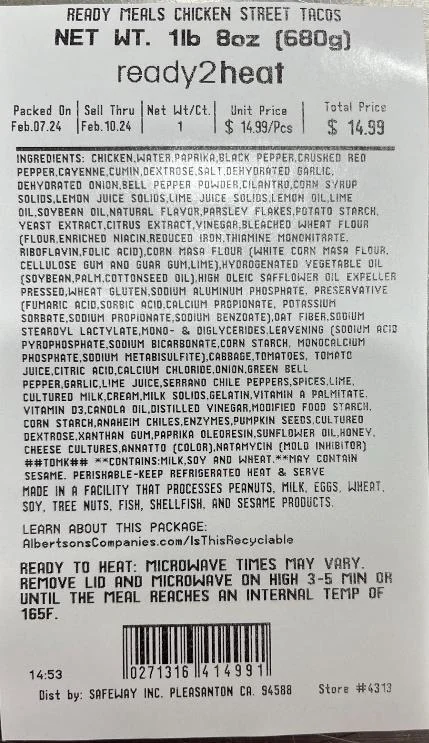
A search for "Safeway recalls 2026" can return older notices because they remain useful public records. Check the year inside the announcement and every affected date. Also look for a completion or termination statement. The February 2024 ReadyMeals and taco-kit notice, for example, now explicitly says the recall has been completed and terminated by FDA. It should not be presented as a newly announced 2026 event.
Keeping an old notice accessible helps someone identify a forgotten package or understand an earlier incident. It does not establish that the same product sold today has the same issue. The reverse shortcut is also unreliable: a recent package is not cleared merely because the first notice you found is old. Search the exact current code and contact the retailer if you cannot resolve the discrepancy.
What the 2025 bowtie pasta update shows
The October 1, 2025 company update, posted by FDA October 2, concerned selected deli products containing a recalled bowtie pasta ingredient. It is a historical example of why the regional row matters. For Basil Pesto Bowtie Pasta Salad with UPC 29492100000, one listed window was September 13 through October 4, 2025 for the specified Albertsons and Safeway distribution in Colorado, Nebraska, New Mexico, South Dakota and Wyoming. Another regional row for that UPC began September 8.
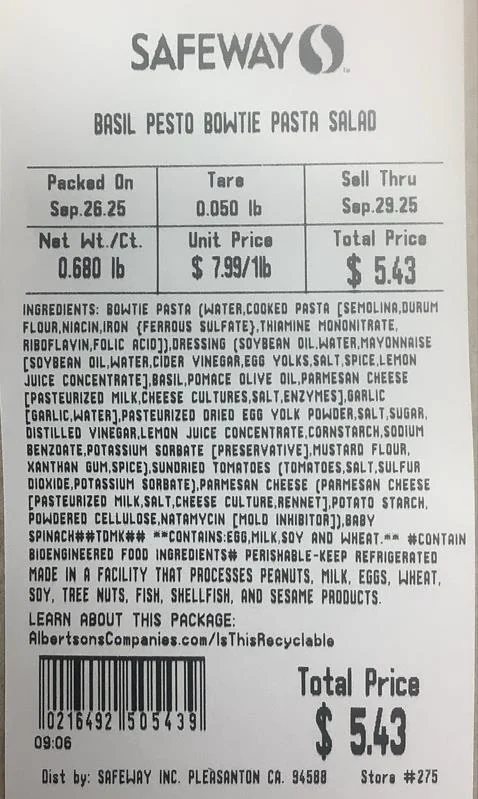
Imagine checking two containers bearing the same food name. A photograph might make both look relevant, but the notice still requires the corresponding code, date and regional scope. Write the matching row beside each package separately. Do not apply one container's answer to the other, and do not use the year of this guide as a substitute for the year printed in the recall table.
When the official page links an original release and an update, read the update first and use the original for context. Preserve the latest link with your notes. That makes a subsequent call to customer service much clearer: you can explain exactly which version you used and which field remains uncertain, rather than asking whether an entire brand has been recalled.
What to do after you confirm a match
Once the identifiers match, remove the item from meals and make sure other household members know about it. Keep the notice open while deciding the next step. A food recall is not a test of whether the product looks fresh. FoodSafety.gov advises against opening or tasting recalled food; the organisms responsible for illness cannot be ruled out by an ordinary smell or appearance check.
Follow the notice-specific return or disposal instructions
The August 2026 example allowed consumers to discard affected items or return them to their local store for a full refund. That does not establish a universal refund rule for everything in the corporate directory. Read the actual remedy, keep the product information, and ask customer service what documentation is needed if your receipt or package is missing. Do not assume that a loyalty account, photograph or bank statement will automatically satisfy the process.
If a container leaks or the food has already been opened, ask how the store wants the return handled before taking it into a vehicle or store. Where the notice directs disposal, prevent other people or animals from eating the food. Do not give an affected product to a neighbor, donation center or pet. A refund question can be resolved through customer service without keeping a suspect meal in everyday circulation.
Clean areas that touched recalled food
The CDC's recall refrigerator-cleaning instructions explain how contamination can reach shelves, drawers and other surfaces. Remove recalled food, clean removable parts and the refrigerator interior with hot, soapy water, rinse as directed, and use clean towels. Let cold glass shelving reach room temperature before exposing it to hot water, because it can crack. Keep other perishable foods from sitting out for more than two hours during the process.
Think beyond the shelf: a lunch container, cutting board or countertop may also have touched the food. Work through what actually contacted it rather than indiscriminately throwing away unrelated groceries. Follow the notice and public-health instructions for foods stored with or touching the recalled item. Wash your hands after handling it and after cleaning.
Get help for illness or an incomplete label
If someone becomes ill after eating a suspect food, contact a healthcare professional and explain the product and timing. Do not wait for a store refund decision to seek care. The CDC lists severe food-poisoning signs, including bloody diarrhea, dehydration and vomiting that prevents keeping liquids down. A recall match alone cannot diagnose the cause of symptoms.
For a missing label, give the company what you do know: store address, purchase date, product description, order or receipt details, and any photographs. For a safety complaint, the government food-problem reporting directory routes reports to the relevant agency. Keep that report separate from your request for a refund so neither task obscures the other.
Keep a useful recall record and check for updates
A short record makes a complicated recall easier to manage. Save the official announcement URL, the version or update date you read, your product's identifiers, the store location, and the action taken. If you contact customer service, note the date and the answer to the specific unresolved question. Avoid writing down account passwords or full payment-card details; those are unnecessary for your own recall checklist.
- Confirmed match: record the matching row and the remedy you followed.
- Unresolved: name the missing field, such as a torn date or unclear store code, and the contact you will use to resolve it.
- No match to this notice: keep the difference you found, without treating it as a guarantee about every possible recall.
Keep different packages separate in your notes. For example, "two salads checked" is less useful than recording each label and the relevant date. This matters when one package was purchased on a different trip, when a family member bought the same food elsewhere, or when an order included a substitution. A single receipt can document a shopping trip but still leave more than one package-level question.
For ongoing monitoring, use official subscription tools in addition to the retailer directory. FDA email updates let you select topics, while the FDA Enforcement Report offers recall and update notifications. FDA explains that classification can follow a company's public warning; a newly classified record is not automatically a newly expanded recall. Our recall-class guide explains that distinction in more detail.
When a relevant alert arrives, reopen the official page and compare what changed with your record. A revised code, date range or distribution table deserves a new comparison. A shared news link or a search through our latest recalls can prompt that check, but neither replaces the package-level match. If an official page will not load on your device, try its linked agency notice or contact the company; a technical access problem is not evidence that there is no recall.
Comments
Comments are reviewed before publication. Do not post personal information, serial numbers, medical details, or emergency reports. For urgent safety concerns, use the official agency contact in the recall notice.
Sign in with Google to leave a comment
Loading comments...