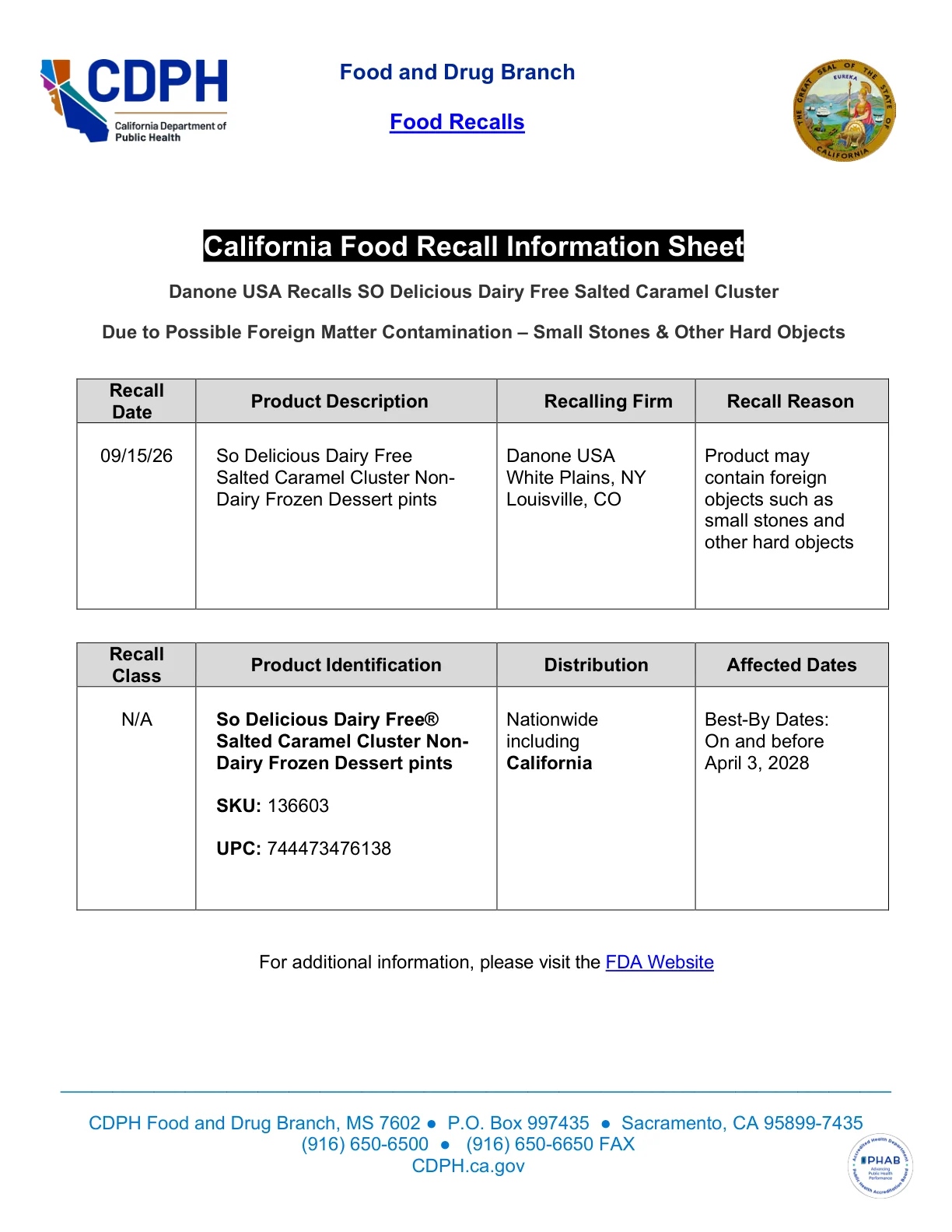
To check a California food recall, open the CDPH Food Recalls page, read the relevant notice and any retail distribution attachment, and match your product's UPC, lot, date and selling location. A company's California address does not establish that your purchase was affected, and a store's presence on a list does not identify every product it sold.
This guide was checked October 9, 2026. It explains the California Department of Public Health lookup route, how to interpret retail lists, and how to verify a California Walmart purchase against the original agency notice. Product Recall Checker is an independent website; official notices and their corrections determine scope and consumer instructions.
Start with the CDPH Food Recalls page
The CDPH Food Recalls page groups commodity-specific notices by month and links to PDF information. It also supplies recall resources and a route for requesting older material. Start there with the product or recalling company, then open the actual document instead of deciding from the month's link title.
On the page checked for this guide, recent entries included dates in July through October 2026. Some were marked updated or expanded. Those labels matter: an earlier version may have fewer products or codes. Record the title and date of the document you opened so another person can review the same scope. The presence of an item in a monthly index is a navigation aid, not a substitute for its affected-product table.
- Read the package name and the company name before searching.
- Find a relevant CDPH monthly entry using those terms.
- Open its PDF and check the original announcement, codes and distribution information.
- Follow any linked agency or company notice for fuller or newer instructions.
- Keep the exact document URL with your package notes.
CDPH says it posts a firm's announcement as a public service and does not endorse the product or firm. Treat the page accordingly: it helps you locate recall information, rather than certifying food outside the listed scope. Nor should a manufacturer located in California be confused with a recall distributed only in California. The document's distribution description answers the purchase-location question.
For food-recall questions, the page identifies the Food and Drug Branch recall coordinator at [email protected] or (916) 650-6607. It directs requests for a particular recall older than the last three months to that email address. These are published information contacts; they are not a retailer refund desk or a channel for an individualized medical decision.
Prepare a concise question if you need assistance: give the brand, product, approximate announcement date and the information you cannot locate. A request for a specific archived notice is easier to answer than a broad request for everything ever recalled in your county. You can also use the linked CDPH recall resources page to understand the state's recall materials.
Read a retail distribution list without overgeneralizing
A distribution list describes where specified recalled goods were shipped. Depending on the notice, that can mean a state-level statement, named retailers, particular addresses, distributors or food-service customers. Read the document's own labels before treating an entry as a store where a shopper bought a finished product. Not every CDPH PDF contains a public list of individual shops.
For example, CDPH's September 15, 2026 So Delicious information sheet explicitly says nationwide distribution including California. It gives product identifiers and affected dates without enumerating every retail address. That is positive California distribution information; the absence of a shop-by-shop table does not remove California from the scope.
Match the location and the product together
When an actual affected-store list is provided, compare the street address, city and state with the selling location on your receipt. Then compare your package with the product table. A location match helps establish the possible purchase route, while the UPC, lot and date identify the product. Neither part replaces the other.
Pay attention to shipment dates. A distribution table's date may refer to the supplier shipping an item to a retailer, rather than the date a shopper bought it. A later purchase is not automatically excluded simply because its receipt date differs from a shipping date. Ask the store to interpret the relevant inventory when the notice does not state a consumer purchase window.
A distribution template is not an affected-store list
The CDPH resources include a sample distribution-list template. Its fields show how customer addresses, shipment information, lots and UPCs can be recorded. It is a blank industry document, not a populated announcement naming affected stores. Do not interpret empty rows as a current recall list or fill them with businesses from an unrelated story.
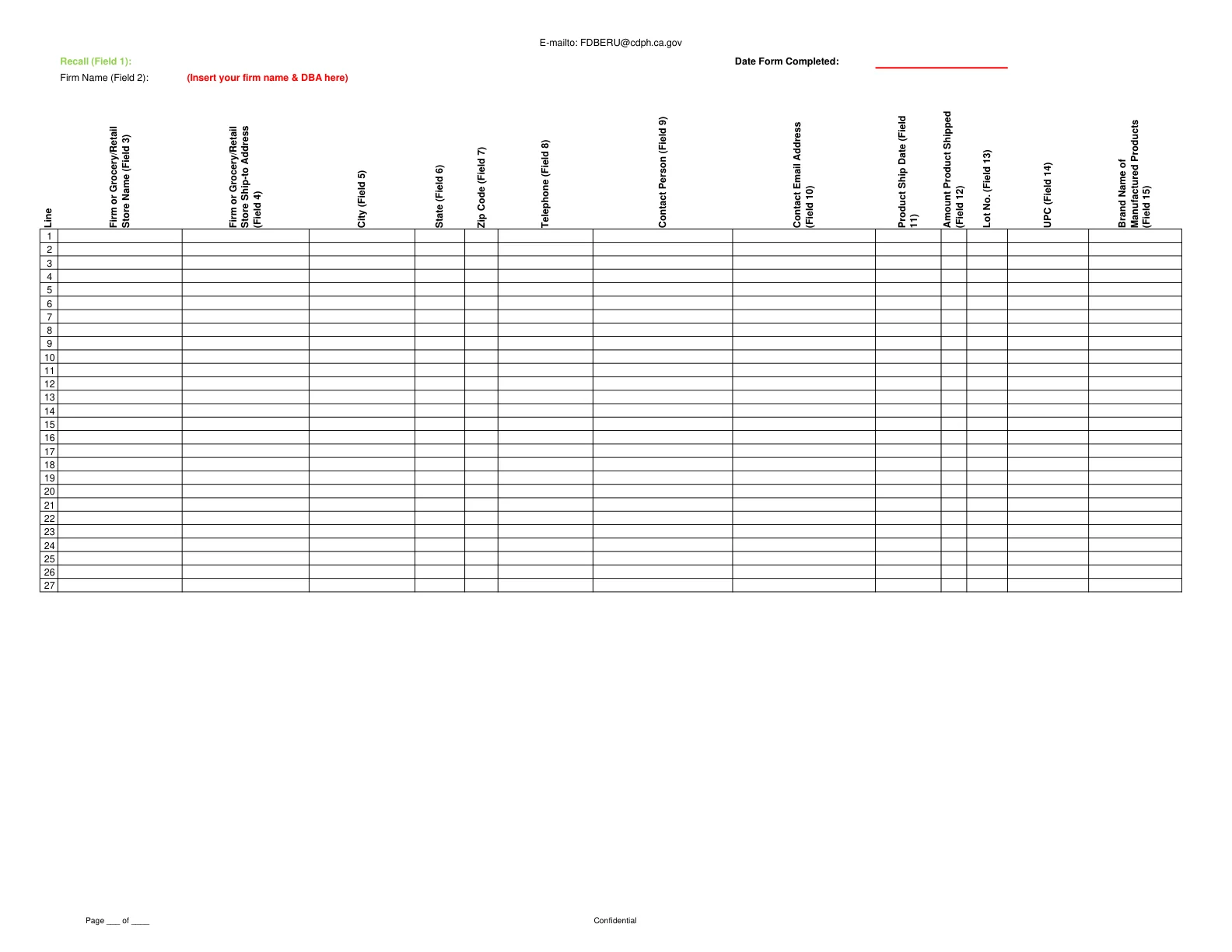
CDPH's industry responsibilities document explains that recalling firms prepare customer distribution information. Consumers checking a grocery purchase need the event's actual notice and seller confirmation, rather than assuming that this template is their personal refund form.
Checking a California Walmart purchase
For a California Walmart purchase, open Walmart's official recalls page and select Food Recalls. Look for the product, then read the state or channel annotation beneath that entry. Walmart also separates pharmacy and general consumer-product recalls, so a food check should begin in the appropriate section.
The page checked October 9 lists California among the states for the September 15, 2026 So Delicious Salted Caramel Cluster frozen-dessert action. This provides a concrete retailer connection alongside CDPH's nationwide-including-California statement. It does not mean every So Delicious flavor in California Walmart stores was recalled.
Save the item link and compare your transaction with the relevant channel. A retailer entry can say selected stores, all states, an online channel or a specified group of states. These descriptions are not interchangeable. If the announcement and your buying route leave a question, ask Walmart about the specific package and store rather than assuming a national chain name settles distribution.
Use the agency notice to finish the match
The linked FDA So Delicious announcement identifies Salted Caramel Cluster non-dairy frozen dessert pints, UPC 744473476138, with best-by dates on and before April 3, 2028. It states that no other codes, flavors or products are affected. Those product fields complete the check that a California retailer annotation starts.
The same announcement tells consumers not to eat affected product and directs replacement-coupon or refund questions to the company's consumer care channel. Read that actual remedy rather than assuming Walmart provides an identical refund process for every event. Our dedicated So Delicious guide explains this particular product in more detail.
Use this case as a method for the next purchase: retailer state or channel, CDPH distribution information where available, and agency package identifiers. Keep all three attached to the same event. A different Walmart recall might involve states that do not include California, or a different hazard and date range. Do not carry the California distribution statement from this dessert into another product's row.
Walmart says its list is not all-inclusive. If no entry matches a concerning package, continue with the agency or manufacturer rather than stopping at the retailer index. For broader Walmart navigation, see our Walmart recall guide.
Choose the right state or federal source
California shoppers should choose an official source by the product and question. FDA handles most foods, while USDA's Food Safety and Inspection Service handles meat, poultry and processed egg products. CDPH information adds a state route and can help you understand California distribution, but the state page does not replace the original federal notice's package scope.
| Your question | Useful starting point | What to verify next |
|---|---|---|
| Packaged FDA-regulated food | FDA notice or enforcement report, plus CDPH | Product codes, dates and distribution |
| Meat, poultry or processed egg product | USDA FSIS | Product, establishment information and notice type |
| California retail distribution detail | CDPH and the notice's retailer attachment | Actual address, shipment and package connection |
| Restaurant or retail sanitation complaint | Appropriate local health department | The official local complaint route |
The government FoodSafety.gov recalls and outbreaks page connects national recall information with outbreak resources. Read whether the item is a recall, public health alert or investigation update. An investigation can explain reported illnesses without supplying the same consumer package list as a recall. Do not convert an outbreak's case count into a count of recalled products.
For a local complaint, CDPH's consumer complaint information distinguishes several follow-up routes. It directs non-illness or injury concerns about restaurant or retail sanitation to the local health department. Use the relevant county or city agency's official contact information rather than sending every local kitchen concern to a retailer's recall refund channel.
Keep your health question separate from your product lookup. If someone is ill or needs care, contact a health professional. A recall coordinator, online database or customer-service reply cannot diagnose the person's condition. The identifying information you collect can support that conversation and any appropriate product report.
For more detailed agency navigation, our Recalls.gov food lookup guide explains the government entry points, and our USDA recall guide covers FSIS records. Finish a California purchase check with the source responsible for that product and the latest notice, rather than choosing whichever page happens to have the newest search-engine date.
Find older recalls and corrected notices
A missing entry on the current CDPH page is not proof that an older purchase was unaffected. The state page concentrates on a rolling group of recent notices. Its instructions direct requests for recall information older than three months to [email protected]. The same page identifies the food recall coordinator at 916-650-6607. These are state information contacts, not promises that CDPH will process a retailer refund. Include the company, product and approximate announcement date when asking for an older document.
For a shelf-stable product or something kept frozen for months, search the relevant federal record as well. The FDA recall announcement index explains its archive arrangement for older announcements. A record's age tells you when it was announced; it does not establish whether your remaining package matches the recalled lot. Keep the original date in your notes instead of relabeling an old notice as a California recall today.
Read version labels before copying product identifiers. The CDPH page reviewed for this guide marked an October 1 Gias notice as expanded and September 25 notices for Fontanini and Sierra Nevada Cheese as updated. Those labels are reasons to open the corresponding documents and compare their scope. They do not, by themselves, identify which products changed or prove that every item under those brands was recalled.
When a state page and retailer page show different dates
The state and retailer indexes can display different dates for a related product notice. For example, the reviewed CDPH index dated a Kettle Cuisine Marketside Tomato Bisque entry August 12, while Walmart's index displayed August 13. The indexes did not establish the reason for that difference. Do not invent a second recall or assume the later date automatically supplies a broader affected range.
Compare the issuing company, product description, package size, codes and linked announcement. If one page links an expansion, retain that version alongside the original so you can see the additional scope. If the identifiers conflict and the documents do not explain why, mark the match as unresolved and contact the company using its official notice. A saved document title and download date also help another household member reopen the same version instead of repeating an ambiguous search.
Build a useful purchase record and follow the remedy
A short purchase record turns a broad California alert into an answer about one package. Photograph the readable label and date code without opening a suspect product. Record the store address or online order, purchase date and receipt if available. Add the official notice title, announcement date and any update date. If a food was transferred into an unmarked container, identify that missing link rather than guessing the lot from another package bought on a different trip.
| Record | Why it matters |
|---|---|
| Brand, exact product name and package size | Separates similar flavors and formats. |
| UPC, lot and printed date | Connects the package to the notice's affected range. |
| Store address and receipt or order | Supports distribution and purchase questions. |
| Notice version and official contact | Supports follow-up about expanded scope or the remedy. |
If the identifiers match, FoodSafety.gov advises against opening or consuming the food. Follow the notice's specific instructions for return, disposal or contacting the company. Do not taste a product to test whether it is safe. A refund instruction for one event cannot be transferred to another event merely because both purchases were made at Walmart or in California. Before carrying anything to a store, check whether the notice calls for destruction instead.
When a notice concerns potentially contaminated food, consider the surfaces and containers it contacted. The CDC refrigerator cleaning instructions explain how to remove affected food and clean the refrigerator. Use that guidance alongside the product notice, including its precautions. Keep photographs and purchase details separately from the food so you can answer questions without keeping an unsafe item indefinitely.
If illness is a concern, contact a healthcare professional and use the appropriate official reporting channel. A matching recall does not diagnose the cause of symptoms. The CDPH consumer complaint page explains state and local complaint routing. Product Recall Checker is an independent website: its latest recall listings can help locate a notice, but the issuing agency and company determine the affected scope and instructions. Keep those original documents with your record and recheck them when an update is announced.
Comments
Comments are reviewed before publication. Do not post personal information, serial numbers, medical details, or emergency reports. For urgent safety concerns, use the official agency contact in the recall notice.
Sign in with Google to leave a comment
Loading comments...